Blog

Five Days of Pure Data - Stop Motion

In the years that I’ve been creating things in Pure Data I have amassed quite a collection of unfinished and messy patches. Over the next few days I’ll be releasing a few of these patches and techniques that I implement when programming in Pure Data.

Stop Motion

It was at the Co-Position meeting of the Libre Graphics Research Unit in 2012 that I first encountered Toonloop. It’s creator, Alexandre Quessy, gave a live performance using lights, Lego pieces and other objects. I was really quite in awe of how stop-motion was used to create quite an enjoyable performance.

Of course my first instinct was to try and recreate this but in Pure Data. I wasn’t the first to try, and I in fact have some memory of seeing Toonloop’s creator himself trying to write something similar in Pure Data although I can’t find any sources…

My first instinct to recreate Toonloop was to use [pix_write] to write a series of images and then play those back using [pix_image]. The problem there is that there’s no easy way to read an arbitrary set of images from a directory.

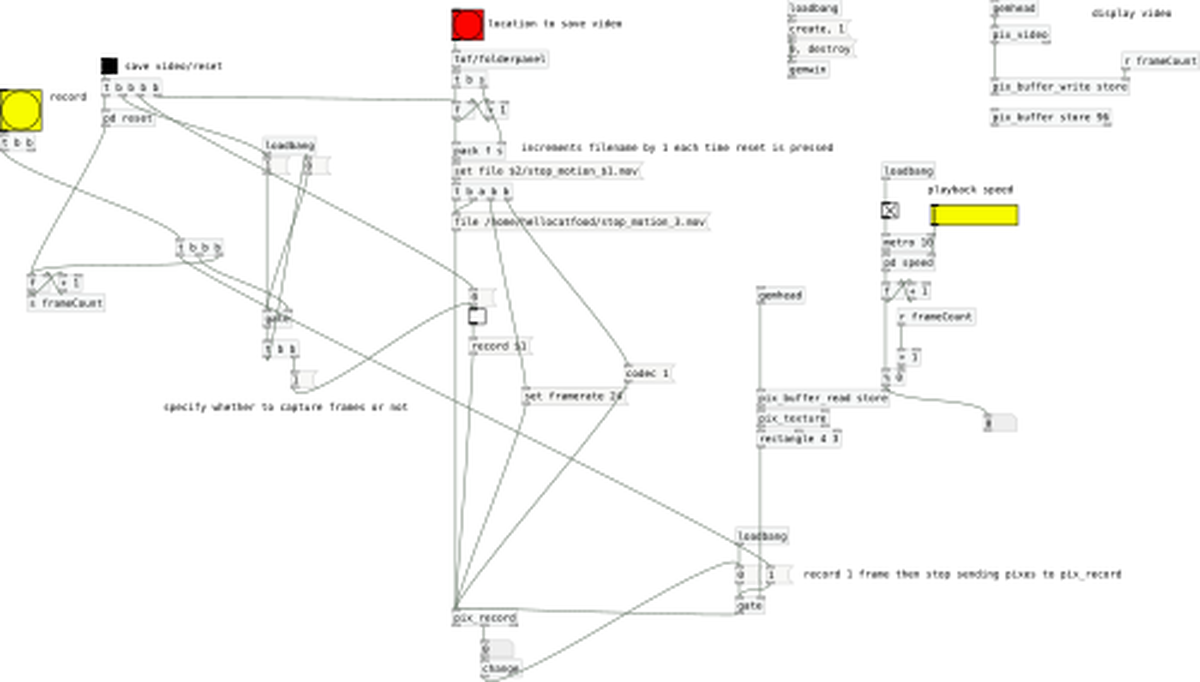
In the end I learnt about [pix_buffer_write] which allowed me to story an image frame into a buffer which I can then call back using [pix_buffer_read]. So that’s the basic functionality sorted! When I went to Databit.me in 2013 Axel Debeul helped to improve the patch a lot. The improvements allowed me to save a video from each animation. You can find the most recent version of the patch below

Five Days of Pure Data - Stop Motion

That’s where the problems start to arise, some of which I haven’t solved yet. The videos are created via [pix_record]. When a frame is captured it is sent to [pix_record] and then recording is paused. However, when you look at the saved video it has a really weird frame rate and doesn’t play smoothly. Even when the frame rate is set explicitly it somehow doesn’t work.

Five Days of Pure Data - Stop Motion

Five Days of Pure Data - Stop Motion

Don't ask me about the cat ears
Don’t ask me about the cat ears

Perhaps making a video out of the animations is something to be done in post processing rather than in Pure Data. [pix_record] has always been a very complicated object to work with so perhaps I need to investigate further and try to find the right configuration of all of its many options.


Five Days of Pure Data - Infinite Scrolling

In the years that I’ve been creating things in Pure Data I have amassed quite a collection of unfinished and messy patches. Over the next few days I’ll be releasing a few of these patches and techniques that I implement when programming in Pure Data.

Infinite Scrolling

For a performance at ChipFest 10 in 2014 I wanted to recreate the look of a scrolling video game but within Pure Data. Sure, I could have just used a console emulator or recorded a clip and used that but doing it all within Pure Data allows me to have some more flexibility with how I perform. Here’s what I made:

I eventually didn’t use it all but I did use the a few techniques I learnt for future performances.

They key to those visuals and for things like 2D side-scrolling computer games is to have infinite scrolling background. That is, to have a single image which tiles and repeats seamlessly as it moves across the screen. Not sure what I mean? check out these examples from TV history:

Five Days of Pure Data - Infinite Scrolling Five Days of Pure Data - Infinite Scrolling Five Days of Pure Data - Infinite Scrolling

Borrowing a bit from this answer on the Game Development Stackexchange, first you create a single tile of size, say, 512x512. You scroll it across the screeen horizontally, and once it’s position gets to 512px (or -521px) it jumps back to it’s original position.

Five Days of Pure Data - Infinite Scrolling

If the original tile is repeated a few times and then offset so that the borders of the tile can’t be seen then suddenly you have an infinite scrolling background! To repeat an object in Pure Data we use the [repeat] object. This object repeats any object and its translations. So, if a [cube] has a translation of 1 on the X axis and is [repeat]ed 4 times, then the first [cube] is offset by 1, the second [cube] is offset by 1 in relation to the first [cube] (or offset by 2 in total). The third cube is offset by 1 in relation to the second cube (or 3 in total), and so on.

In action this looks like this:

Five Days of Pure Data - Infinite Scrolling

Success!

You can also do the same with the Y and Z axis. For the Z axis you just need to decide where the vanishing point is. Or you could always use fog ;-)

The patch for this is really quite simple but I’ve made it available for download below:

[Click to download](images/infinitescroll.zip)
Click to download

Five Days of Pure Data - Randomise Text

In the years that I’ve been creating things in Pure Data I have amassed quite a collection of unfinished and messy patches. Over the next few days I’ll be releasing a few of these patches and techniques that I implement when programming in Pure Data.

Randomise Text

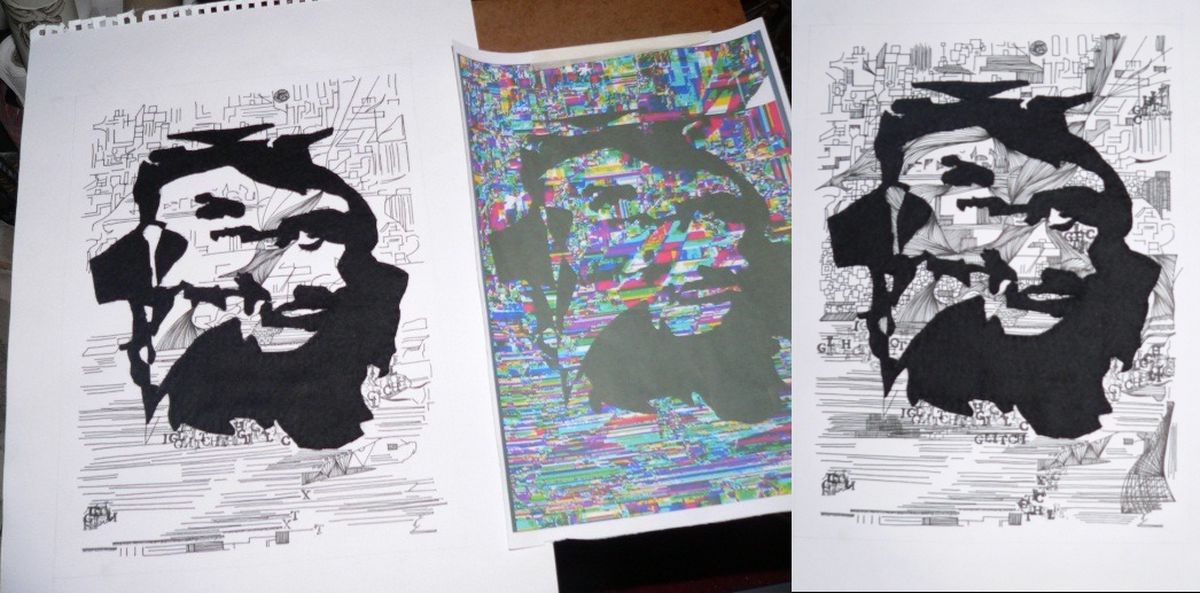
In the early 2010s I had quite an interest in zines. I had co-organised the Birmingham Zine Festival and was quite regularly reading this. As a result of this in 2011 I started collaborating with a friend, Rebecca Evans, on a collaborative zine. The concept is that we would interpret each others’ way of working using our regularly used tools. Rebecca specialises in textiles and has quite a skill at crocheting, amongst other things. I, on the other hand, can barely operate a sewing machine and feel much more at home using a soldering iron or computer.

For Rebecca this meant trying to create some sense of noise and randomness but using sewing. The results, even if only tests, looked quite awesome!
Five Days of Pure Data - Randomise Text

For my own take on this I wanted to continue the text based work that I was creating at the time. Rebecca two poems to work with, Lovesong by Ted Hughes and Lady Lazarus by Sylvia Plath.

I wanted to remix the works by jumbling the words and/or sentences. Looking at recent(ish) work you can see that this would become a bit of a theme in my work and references. spɛl ænd spik, Silver Screen Changeable, and my reinterpretation of Variations on a Themeby Casey & Finch by Erik Bünger each look at cutting up and rearranging words.

Cutting up words and rearranging them can be achieved in many languages using just a few lines of code. One method is to put each word or sentence into an array and then print those indexes in the array randomly. In Pure Data it isn’t as easy.

For most cases Pure Data has the [tabread] and [tabwrite] objects. To use [tabwrite] you specify the index and then write data to it. You then move onto the next index number and write more data to it. To read the data back you do the inverse but with [tabread]. This works great with numbers but not with text.

Y’see, Pure Data has several data types. Just like php, python and others have strings, numbers, text, etc, Pure Data has symbols, floats, integers etc. The character “6”, for example could be a number (default) or a symbol - using a combination of a number box, [floattosymbol] and then a symbol box. As a number it can be used in arithmetic operations, as a symbol it’s good for when you don’t want it to be treated as a number. The unfortunate thing for me/us is that [tabread/write] doesn’t accept symbols, only numbers. Damn! Enter [m_symbolarray] from rjlib.

Five Days of Pure Data - Randomise Text

Using this abstractions you can put symbols into an array in the same way as numbers. With that problem solved I now could decide whether I wanted to jumble words or sentences. In the former case it would be unlikely to return anything that makes sense, which is ok. In the latter case it could still produce interesting results that could fool some people into thinking it was as it should appear. So, it was important to have the option to do both.

Using [textfile] you can specify what a delimiter is. A delimiter specifies where one list item stops. By default [textfile] uses a space as a delimiter. By sending the message [read textfile.txt cr( to [textfile] I can tell it to use a carriage return (Enter key) as a delimiter. Unfortunately there isn’t great documentation on what the others are!

Using the [until] object and a carefully crafted series of operations I crafted a patch to do the following: Decide on delimiter, read the text file, output each list item to the [m_symbolarray] object, cycle through text file and do this until we reach the end of a text file.

Five Days of Pure Data - Randomise Text

With the table now populated here’s where the interactive part comes in. A user could decide to either dump the contents of the array into a text file or spit out each item to, say, a [text] object for displaying on a screen.

You can download the finished patch below:

Five Days of Pure Data - Randomise Text

Below are my remixes of the two poems for you to download:

Lady Lazarus by Sylvia Plath

To annihilate each decade. Flesh, bone, there is nothing there– To the same place, the same face, the same brute

I am your valuable, Herr God, Herr Lucifer It was an accident.

Them unwrap me hand and foot– And pick the worms off me like sticky pearls. And like the cat I have nine times to die.

Out of the ash Comeback in broad day A gold filling.

That melts to a shriek. The first time it happened I was ten. I manage it–

The grave cave ate will be You poke and stir. A wedding ring,

The peanut-crunching crowd It really goes. Do not think I underestimate your great concern.

Lovesong by Ted Hughes

Her looks nailed down his hands his wrists his elbows His smiles were the garrets of a fairy palace He wanted to topple with his arms round her His kisses sucked out her whole past and future or tried to Her kisses were lawyers steadily writing His promises were the surgeon’s gag In their entwined sleep they exchanged arms and legs

Her smiles were spider bites Her eyes wanted nothing to get away He wanted all future to cease Of a lopped melon, but love is hard to stop Their little cries fluttered into the curtains Her promises took the top off his skull His caresses were the last hooks of a castaway And their deep cries crawled over the floors

it’s a shame that the zine was never finished but it was still a great learning experience.

I’m sure that by now the relatively new [text] object can solve many of the problems I had using [textfile] to read the file, so perhaps at some point in the future there will be an update.


Five Days of Pure Data - Image to Signal

In the years that I’ve been creating things in Pure Data I have amassed quite a collection of unfinished and messy patches. Over the next few days I’ll be releasing a few of these patches and techniques that I implement when programming in Pure Data.

Image to Signal

If you’re into experimental ways of creating visuals and happened to be on the internet around 2013 you have have been sent information about software called PixiVisor. The software, developed by Alexander Zoloto, allows one to transmit an image via an audio signal to another device which decodes it and displays it as an image. In this way you can then apply audio effects to the signal and make some pretty cool visuals. I never tried it myself but was quite impressed by what I saw.

Being the open source kinda guy that I am, and a devout use of Linux I was interested in knowing if there was a way of reproducing this using open source software.

sloev got in touch with me some time later in 2013 to demonstrate a Pure Data patch he made that quite faithfully reproduced PixiVisor in Pure Data!

Like PixieVisor this worked by having two devices, one to transmit and another to receive. I quite quickly and roughly rewrote the patches so that this process was done all in one patch. Its first outing was the 2013 Pecha Kucha event in Coventry where I provided visuals for Ashley James Brown/Arctic Sunrise.

The patch works by using the [pix2sig] and [sig2pix] objects. As their names suggests they convert audio signals to pixels and vice versa. The key to how the Pixievisor remix patch works is setting the block size. This tells your computer how many audio signals to process per frame and therefor how many pixels.

By default on Pure Data this is set to 64, which would allow us to work with an image 8 x 8px which is tiny.By increasing the block size to 4096 we can begin to work with images of size 64x64 (because 64 x 64 is 4096).

Five Days of Pure Data - Image to Signal

You might now be thinking that you can increase the block size and work with higher resolution images. Well, that’s not really possible unless you want to sacrifice frame rate. If we take a commonly used video resolution, 640 x 480, you would need a block size of 307200. Try doing this and come back when your computer has done crashing ;-)

With sloev’s blessing I am now releasing this modified patch.

Five Days of Pure Data - Image to Signal

The patch is set to use the webcam as an input but it can accept any media input that Pure Data can handle. If you don’t want to have to resize everything before bringing it into Pure Data you can always use [pix_resize] to, um, resize your input live. This has the added benefit downside of putting extra strain on your computer.

Perhaps it’s a dream that will never come true, but it would be good to one day be able to have a completely open source, multiplatform solution for video synthesis. I like the look of Lumen but unfortunately it’s Mac only :-( Until then, hope you enjoy the patch!


Green Man Festival, 17th - 20th September

From 17th - 20th August I’ll be at Green Man Festival in Brecon Beacons to present new work, Mirrored, commissioned by the festival:

Green Man Festival, 17th - 20th September

Antonio Roberts is a new-media artist and curator based in Birmingham. His practice focuses on the errors and glitches generated by digital technology. For Green Man 2017 he will create a new work inspired by seeing Battles at the festival last year. “Mirrored” (named after Battles’ first album) is a number of perspex cubes between 60 and 100cm square, each etched with his characteristic imagery depicting scenes from the festival. “Mirrored” is a development of recent work made for Short Circuit Project, Copenhagen. It builds on a recent interest in presenting his work off-screen and he will be working outdoors for the first time.

I’ll also be performing alongside awesome folk at the Alograve in Einstein’s Garden. Gonna be dope.

By the time the festival starts I will have been at the festival site for over a week so please send/give hugs and warm food plzkthxbai.