TROVE, whom I recently did an exhibition with, will be celebrating its third birthday on 12th October 2012 5-9pm. To celebrate this occasion they’ve invited past artists and collaborators to exhibit some work with them
Over the past three years TROVE have worked with 146 local, national and international artists that have created, exhibited and performed as part of TROVE’s programme. TROVE have realised over 36 shows in the wonderful TROVE home, the Old Science Museum, and in offsite projects, with venues including Curzon Street Station, mac birmingham, Edible Eastside, DownStairs Gallery, FarGo, The Burlington Fine Art Club, Coexist and ARC. TROVE is an independent art gallery who have worked with Fierce Festival, Hereford Photography Festival, Hedge Enquiry, Minnie Weisz Studio, Museum of Lost Heritage, Birmingham Architects Association, Birmingham City Council, Clarke Gallery, Birmingham City University and Crowd 6. At Pop! Bang! Wallop! there will be presents, piñatas and pass the parcel! There will be artworks and cards from past TROVE artists! There will be a bouncy castle! And much much more!
Come and celebrate TROVE’s 3rd Birthday on 12th October 2012 5-9pm.
TROVE, Newhall Square, off 144 Newhall Street, Birmingham, B3 1RY
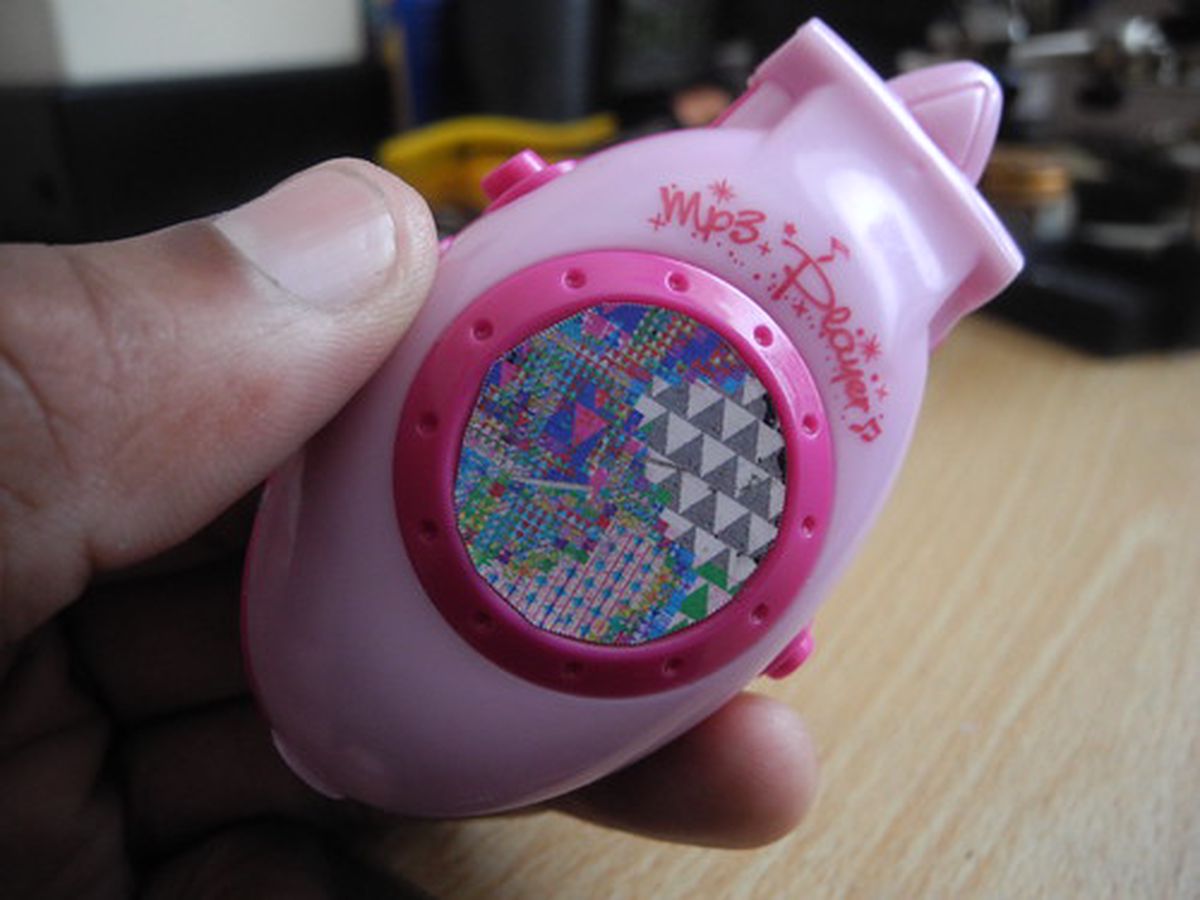
To celebrate the occasion, in addition to making/glitch a birthday card, I circuit bent a toy for them:
I received this toy as a present from the micro residency that I did in 2011 at Fargo Hack Play Space. Although it’s really small, this toy contains a lot of bits to bend and break! The toy originally played several nursery rhymes, contained a single-purpose light and had its own speaker and headphone port.
Using great science a lot of guesswork I added in a light-dependant resistor to control the speed of playback, repurposed the light switch to reset the device and made the light only turn on when noise is being made. Pressing and holding the play and skip button causes the speed of playback to double (or triple). I also replaced the sticker on the front with some of my own art. The below video probably explains it a lot better than words ever could:
(If pictures are worth 1000 words then the above video is worth 2095000 words)
I’m happy to announce that I’ll be taking part in Databit.me #2 in Arles, France from 13-20 October.
What is Databit.me?
With workshops, conferences, residences, performances and video & musical evenings , the third edition of Databit.me invites you to discover the mysteries of digital art in all its forms 13th October to 20th October …
This year Databit.me offers an “electronic free market” on 14th October 2012 in the main venue of the festival in the centre of the city of Arles. As in previous editions, we will conclude with party and its international line-up, that showcases electronic music, VJ and other digital experiments, several of them will be create during a session of residencies during the week.
In short, lot of artists to discover, throughout the week.
Time of the first computers is not so far away. What remains today of these machines, software programs, practices, …? The future of digital files also seems very uncertain and computer languages today could soon become “dead” languages of tomorrow. Create an archeology for computing is an actual question…
Open Camera
I’ll be working throughout the week with Gijs Gieskes and others to create an “Open Camera” that is built from easily accessible components.
For Some of My Favourite Songs I utilised Pure Data Extended (I’m using a beta version) to read the audio files and then save them as images. Pure Data is usually used for the production of music and/or generative live visuals, so to using it to produce jpg images from almost nothing, or random data input is quite new to me!
In search of a jpg header
The most important part of this process is knowing how to construct and apply a jpg header to data. Wikipedia informed me that all jpg images begin with FF D8. I thought that all I would need to do is use a hex editor, such as Ghex or Bless Hex Editor, to add those byte values to a file.
Unfortunately this is not the case at all. There’s so much more in a jpg header, such as Huffman Tables, Quantization Tables, bytes to define the width and height of an image, and much more that I still don’t quite understand.
I attempted to grab data from the beginning of a random jpg file, but this included lots of extraneous data such as camera make, program(s) used to modify the photo, gps data and creation date. This data amounted to several kilobytes, which is far too much data for a header. What I needed was a “vanilla” or plain header that I could apply to any file.
mesmeon showed me the HEADer REMIX project by Ted Davis. The header values on the left of the screen are used for glitching every image, be it the default image or one taken by a user.
I saved the default image, manually extracted the header image, ran it through exiftool and then ended up with a header for a 640x480 image that is only 588 bytes!
Enter Pure Data
Now that I had a vanilla header I had to devise a way to use it in Pure Data. The [binfile] object allows the reading and writing of binary data. Adding data to [binfile] is a case of sending a message containing numbers to the object.
[binfile] reads and outputs data as decimal values i.e. numbers from 0 to 255. I needed to find a way to add the decimal values of the vanilla header to a message box. Martin Meredith helped me with this whilst we were tackling bugs at the Ubuntu Global Jam. Using hexdump I was able to output all of the hex values to decimal values.
(The output is sent to a text file for ease of copy/pasting)
With this output I copy/pasted the values into a message box, and whenever I needed to add a jpg header to a file I clicked on the message box! To then write the file I sent the message [write filename.jpg( to the [binfile] object.
A jpg header in Pure Data
Using this data alone you may notice that the jpg image doesn’t open in certain image viewers or is blank/black. That is because all that was added is the header. Image data is also needed! For this I added a few [metro]s to generate random numbers between 0-255. The output image then looks a little bit more colourful now.
jpg created by Pure Data
For some websites and image viewers the End Of Image bytes (FF D9/255 217) need to be added in order for it to be viewed properly. To start this process again send [clear( to [binfile]. This clears all binary data. Below is all of this theory put into one patch.
To use it, first click on the button to start the jpg file, then click the toggle button to add lots of random data. This may take a minute or so. Once done turn off the toggle, click on the button to end the file and then write the jpg image.
Further options
If you know the structure of a certain file type, in theory, it is possible to construct one in a similar way to this. I’ve already used this method to construct a bmp, but they produce far less interesting results. png files seem to be more fragile and, as such, I haven’t managed to create one using this method.
If you use a second [binfile] object you can load the bytes from another file and use them, in conjunction with random data, to produce glitchy - but slightly recognisable - images!
Is it also possible to reduce the size of the jpg header even further?
Create jpgs in SuperCollider
Holger Ballweg (uiae) has recreated this progress in SuperCollider. Check it out!
In early 2012 I made a music compilation that attempted to summarise my musical tastes on a 700MB/80 minute CD. ‘cause I’m a special kinda guy I’ve decided to share it wit y’all… as images! Below are some of my favourite songs, presented in the order that they appear on the CD. You should listen to them.
The images were made by reading the audio files into Pure Data as binary data and then saving them as jpgs. I’ll do a writeup of the process soon!
BZF (formerly Birmingham Zine Festival) is back for its third annual festival from 12th-15th October and once again - though for the final time - I’m happy to be part of the team organising it!
All of the events are still being planned, but as usual there’ll be the Independent Publishing Fair which has over 30 exhibitors!. All other events and information can be found on the main website. If you’re a social media use why not “Like” and “Follow” BZF on Facebook and Twitter.



](/blog/create-jpgs-in-pure-data/images/header_remix_hu_171a189e54f73843.jpg)


](/blog/create-jpgs-in-pure-data/images/pd_binfile_2_hu_3a3ff82fde7bb35d.jpg)