What happened to my website?
I started writing this blog post in the Summer of 2024. At the time I was on a game development course where we had a workshop on building a successful portfolio website. Many of us held our heads in shame as we looked at our horrible, barren, and outdated websites.
Shortly after this wake-up call I published a “back soon” blog post and hoped that I’d find the motivation to finally give my website some attention. Of course “back soon” turned out to be nearly two years. I’m now here on June 3rd 2026 returning to this half-written blog post which explained my absence but this time with an actually presentable website. So, let’s return to the original provocation of this blog post: What happened to my website and what can you expect going forward?
The tl;dr answer is that Wordpress became unbearable to use, the other services I relied on became shit, and a secret third thing which I’ll talk about in a later blog post.
Wordpress, why are you like this?
Since the beginning of time (2008 I think) my website was built on Wordpress and focused on blogging. Prior to Wordpress I was a livejournal user and so the idea of blogging felt natural to me, which Wordpress excelled at. Eventually, though, I really needed a way to showcase artworks without asking viewers to have to scroll back through the feed to find specific artworks. Since around May 2014 I used the Touchfolio theme which mostly solved this. It gave me a way to put images and videos of a project on the front page and add a short description. It did most of what I wanted with a few quirks.

However, despite its popularity and mostly open source status, it was rarely updated and the bugs started to pile up. One issue was that Wordpress’s newly introduced custom widgets feature wasn’t supported. In general, Touchfolio seemed to implement its features in its own custom way and wasn’t being updated to do things in newly introduced “Wordpress” ways. So, any new features were a no go for me. For the most part that didn’t matter. I just needed to use Touchfolio’s in built gallery features and blog posts. As long as that worked I could mostly ignore its shortcomings.
Then, one day, the whole site broke. I can’t recall exactly what happened, but I think Wordpress dropped support for older versions of jQuery or some other software in the early 2020s. Bug reports on github suggest this happened around 2019 or 2020. There were various hacks and temporary workarounds but eventually, around April 2021 the solution was to drop the front page gallery, turning my website back into a blog.
What happened next is still a bit hazy to me. Either the Touchfolio theme became more incompatible with newer Wordpress versions and stopped working or I became sick of having an outdated theme. In any case around July 2023 the theme changed once again to one of Wordpress’s default themes.

Then, finally, some time in November 2024 I decided to replace my whole website with a one-pager that had some basic information, contact details, and links to places like instagram and youtube where you could find more up-to-date information. My website had gone from being useful repository of information and archive of my projects to being a functionally identical but expensive linktree that pointed people to other websites.
Fuck plugins, all my homies hate plugins
Alongside my theme breaking I was also battling with plugins. Plugins were one of the big features of Wordpress. I liked the idea that any problem you had could probably be addressed with a plugin. One of my favourite plugins was the Broken Link Checker. Link rot is definitely a real problem and so being able to identify broken links across my website and replace the link with a Archive.org link was great.
Over time I noticed the plugins becoming worse. To use a modern term they became enshittified. Plugins that were once independent were being acquired by larger plugin developers like WPMU Dev. Some started asking if they could track me, or prompting me to upgrade to a premium version. The most visible sign of the enshittification of plugins was when they turned my Wordpress dashboard into an advertising nightmare. So many requests to upgrade to premium that I never asked for.

This screenshot was from June 2026 but it has definitely been this bad for a long time.
Plugins can of course just be disabled, but my issue was that I had long relied on a few for core functionality. For example, I used The Events Calendar and Events Calendar Shortcode plugins for my events page. It provided a really easy way to display events show more information. However, with each update brought the possibility of enshittification. I don’t remember if The Events Calendar did the ol’ bait and switch and put once core functionality behind a paywall, but tbh I stopped inputting events in the early 2020s and I didn’t want to stick around to find out.
Dependency hell
In the early 2000s/2010s APIs were the all the hype. The idea is that you would put all of your data, e.g. tweets, listening habits, reading lists, into a service and then you or anyone could utilise an API to interface with that service and potentially build services on top it. This is why, for a time, there were a number of alternative twitter clients, or widgets that would display your last.fm listens or recent Facebook updates.
Having all of these connected services was actually quite cool. btw do you also hear that foreboding music too? Anyway…
An external service I relied on heavily was Flickr. Very early on I was using Gallery 3, which is why some very early posts have these weird embed codes instead of images. It was functional but also a bit cumbersome whereas Flickr seemed to understand that artists and photographers wanted an easy way to view and share photos. For a very long time nearly any photo or short video was an embed from Flickr. It was so useful that I even bought a pro subscription.
By 2020 I was using Flickr less and less. This could have been due to using instagram more (I even toyed with having a separate artist account for a time), but also lockdowns had just started and so there were fewer opportunities for me to take photos to upload.
For a few years I begrudgingly kept paying for a pro subscription. By this point Touchfolio had stopped working so the albums for each artwork and project became my pseudo-portfolio. But over time I resented paying for a service that I was barely using. I only kept paying because some others relied on it (e.g. Algoravers used photos I had taken for press shots) and I had invested so much time and effort into it (sunk cost fallacy anyone?).
Once Flickr raised their subscription prices a few too many times I decided it was time to stop paying. My account reverted back to a basic one and I got warnings saying that photos that went beyond my free account quota would be deleted. The only concern I had about this was that if photos beyond a certain date or count were deleted many blog posts would have gaping holes where photos once were.
I honestly now regret relying on these external services so heavily.
And it’s not just Flickr. I have similar feelings about Vimeo. For a few years I had a pro account. Once I stopped paying I was assured that uploads that went beyond my free account quota would still be accessible but I just couldn’t upload any more. Then, in May 2026 they reversed this and there are probably now videos which are inaccessible.

Back to basics
All of this showed me that using Wordpress with other services for embedding media/content wasn’t working. It used to work but the internet changed, and my needs changed. So I began the long task of finding an alternative.
So many artists and graphic designer friends and peers have really nice websites built on top of Squarespace, Wix, or some other portfolio service. I briefly considered this as it would make my life so much easier but I would essentially be trading one walled garden for another. Whatever framework, CMS, or service I did adopt would have to do a few things:
Portfolio and project pages
Honestly, I liked the Touchfolio full-page showcase (I think this is called hero images). It would have been great if those linked to project pages where I could show more information.
RSS feed
RSS does one thing and it does it well: It lets people subscribe to and read my blog. Sure, it’s not new and fancy, but it works.
Import existing blog posts
This is one of the most important requirements. My blog has posts going back nearly 20 years. In many ways I see my website as a resource for other people. It is a showcase for my work but it is also where I share progress updates, code, and tutorials, the most well known of these being my Databending in Audacity tutorial.
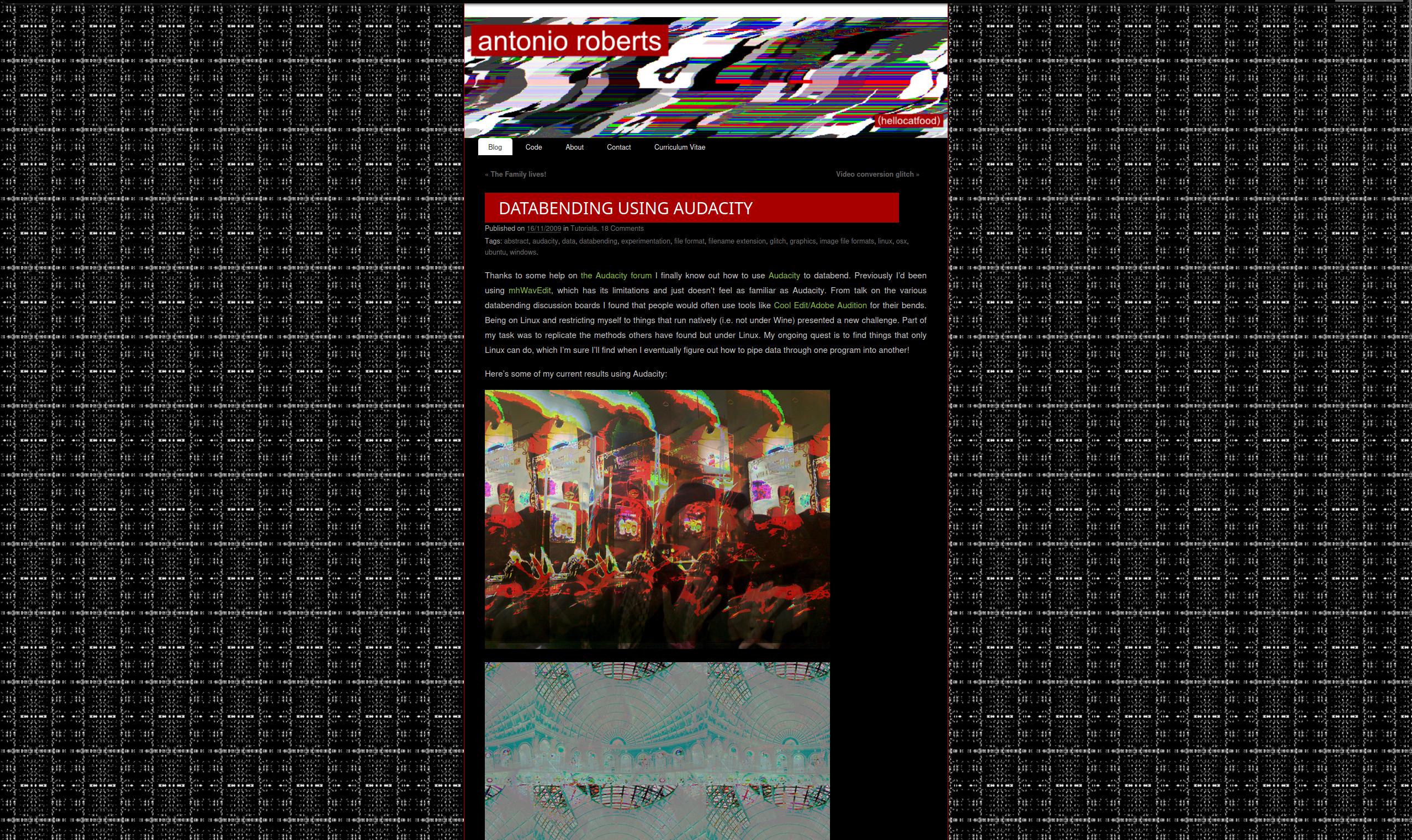
It was posted in 2009 and in the years since it has been referenced, linked to and replicated so many times. Sure, it doesn’t show at the top of search results anymore, but I feel that this is an important part of glitch art’s history and so I want to try and preserve it as much as possible.
Then there’s my other tutorials such as Seamlessly loop Wave Modifier in Blender, Datamoshing using Avidemux 2.7.0, and (mis)Using FFmpeg’s Motion Interpolation Options. These posts provide specialist information to a small group of people but I still want to preserve it and have it be of service to others who have the same unique needs that I do/did.
If the service or framework that I adopted couldn’t import blog posts then it would have been a no from me.
So, in reality if my new website could be like Wordpress + Touchfolio in 2014 then I would be happy.
A new challenger approaches
I had heard of static website builders for a while. Conceptually they are like like a modern day equivalent of Dreamweaver or Front Page Express in that you do all of the building and editing locally and then upload it to a server. One difference is that you keep the content and theme/styling separate: you write your content in markdown files and it takes that content and builds the website for you. No server-side dynamic page building at all!
When I started (Algo|Afro) Futures in 2021 I needed a very basic site for it and so chose the Hugo static site builder. I don’t know if there was any big-brained process behind this decision but I liked how it worked. Most importantly it was lightweight and fast. I could do an update and be confident that there would be no plugin or backend updates that would break the site. I could set it and forget it. This positive experience convinced me to use Hugo for my redesign.

Migrating was a gargantuan task, and one that is still ongoing. As mentioned earlier, I had two decades of blog posts to migrate, and then there was embedded content from Flickr that was going to disappear so I needed to account for that too. Fortunately for me there are a few plugins and services for migrating. I think I used this WordPress to Hugo Exporter which had the added feature of including any embedded media in its export. This meant all external Flickr photos were included! I would still have to do manual work to get attachments working and redirect some links, but this saved me a lot of work.
I had this exported archive sitting in various location on my computer for maybe two years before I got the motivation to do the migrating.
Relaunch
2025 -2026 saw the website rebuilding process pick up pace and now it’s in a fairly usable state. I think I officially uploaded the new site on 5th July. The most remarkable thing about it is that, well, it’s unremarkable! It doesn’t do anything other than display my art, events, projects, and blog. On the viewer-facing side the most “fancy” thing is does is have an image carousel on the front page. On the user-facing side (that’s me) I’m just happy I have a reliable way to host and update my art. Of course there’s always a chance that Hugo could become unmaintained, but having everything in plain text files that can easily be parsed (thanks yaml!) means that it’s easy to migrate should I need to do it again.
The future
Now that my website is back, what now?
I’ll be gradually adding old projects, fixing links and embedded content, and making sure that my archive is up-to-date. For example, you may have seen that I have events listings going back to my graduate show 2007! Many of those listings still have their original event urls. 99% of people won’t look at anything older than two years, but for me it’s important to have a record of everything that I’ve done. As a solo freelance artist I find all too easy to fall into pits of despair, particularly after waves of rejections or comparing myself to people on Instagram. Seeing my events listings and old projects helps to remind me that, even in periods of down time, I have accomplished things and I hopefully will again in the future.
I can also see myself getting back into blogging again. In fact, I already have been posting a few things since relaunching. I prefer blogging over (or in addition to) posting social media as there’s a sense of permanence. For example, Sometimes I like to write essay-length posts on Mastodon, and on occasion a late-night sketch gets lots of attention on Instagram.
I’m glad that there’s an audience for these posts but after a day or two they get lost in the feed. I would spend hours agonising over how to distil an idea into Instagram’s rigid formats or Mastodon’s content limits (word count, images or videos, not both), find an optimal time to post, pick my best/most optimised content only for the post to get little attention and then promptly get lost in the feed.
Sinking so much time into posting on social media feels like lost time. But, I recognise that it is necessary for artists and musicians to have a presence on these platforms. So, I will continue to post on social media, but for when I really want to do a “deep dive” into a topic or have something more permanent that I can point people to I will post/cross-post onto my blog.
Overall, I’m just happy to once again have a place for my art and writing that I can call my own.