tag: Databending

A Short Introduction

Since I was introduced glitch art last May I’ve really been hooked on exploring this technique and how it can affect my artwork. One thing that I’ve never done is to explain why I do this, so here it goes!

For me glitch art is about exploring the boundaries in which things will operate as expected, with particular emphasis on computers. Computers are very complex and can take years to understand understand. Computers are also very obedient. They will do what you tell them to, but you have to tell them in a way that they understand. For example, it is assumed that if you double-click on an image it will open in an image viewer or editor. This is because the image has data in it (the header data) describing what kind of file it is and when you double-click on it an instruction is sent to open that kind of file with any program that can interpret it that data.
It's Just Noise!

As readers of my blog will know by now you can easily import any data into audacity and play it as audio. However, most data that you’ll import and then play will just turn out as noise. That is simply because there’s too much noise in the image i.e. too many colours and too much data. So, if you reduce the amount of colours and data in theory you get something a little bit more pleasing to the ear. Experimentationing time!


Preserving the glitch

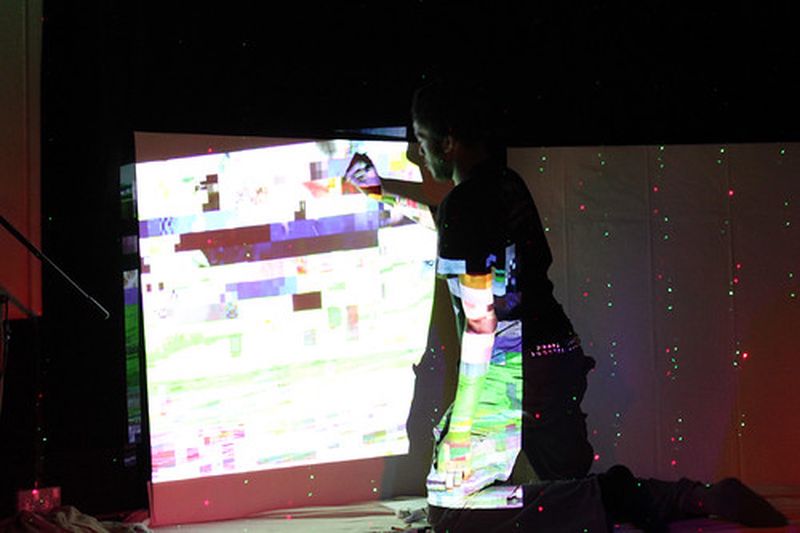
On Thursday 4th March I took part in the AntsArtJam at BitJam in Stoke-on-Trent. Three canvases were set up on the stage and artists were invited to get creative on them as the night went on.

Antonio Roberts (by These Ants)
Photo by These Ants

Those who know me will know that live art is not something that I’ve really done before. I’ve done a fair bit of performing, but nothing like this, so it was quite an exciting challenge.


Visualising BitJam

On Thursday 4th February I was Stoke-on-Trent for BitJam. I still don’t have anything ready to show on stage but thought I’d use the night as a testing ground for some of my ideas. I wanted to investigate ways in which to interpret what was happening around me. The main performance of the night was from a chap called Arctic Sunrise

For my first test I fired up Alchemy and attempted to draw the music. Alchemy fortunately has a few tools that can make your sketches react to sounds. They are Create > Mic Shapes and Affect > Mic Expand. Here’s the result of using both of them together


Streams of data

One of my overall goals is to find a way to databend live video. I’m sure there’s a way to do it with Processing and PureData but I’m not yet proficient in those programs so they’re out of the question for now. In the meantime I thought to try and hack the Echobender script to databend my webcam images.

tonyg provides a great tutorial on how to convert live webcam images into audio, which I’ve used as a starting point for my hack.


Moo mini cards

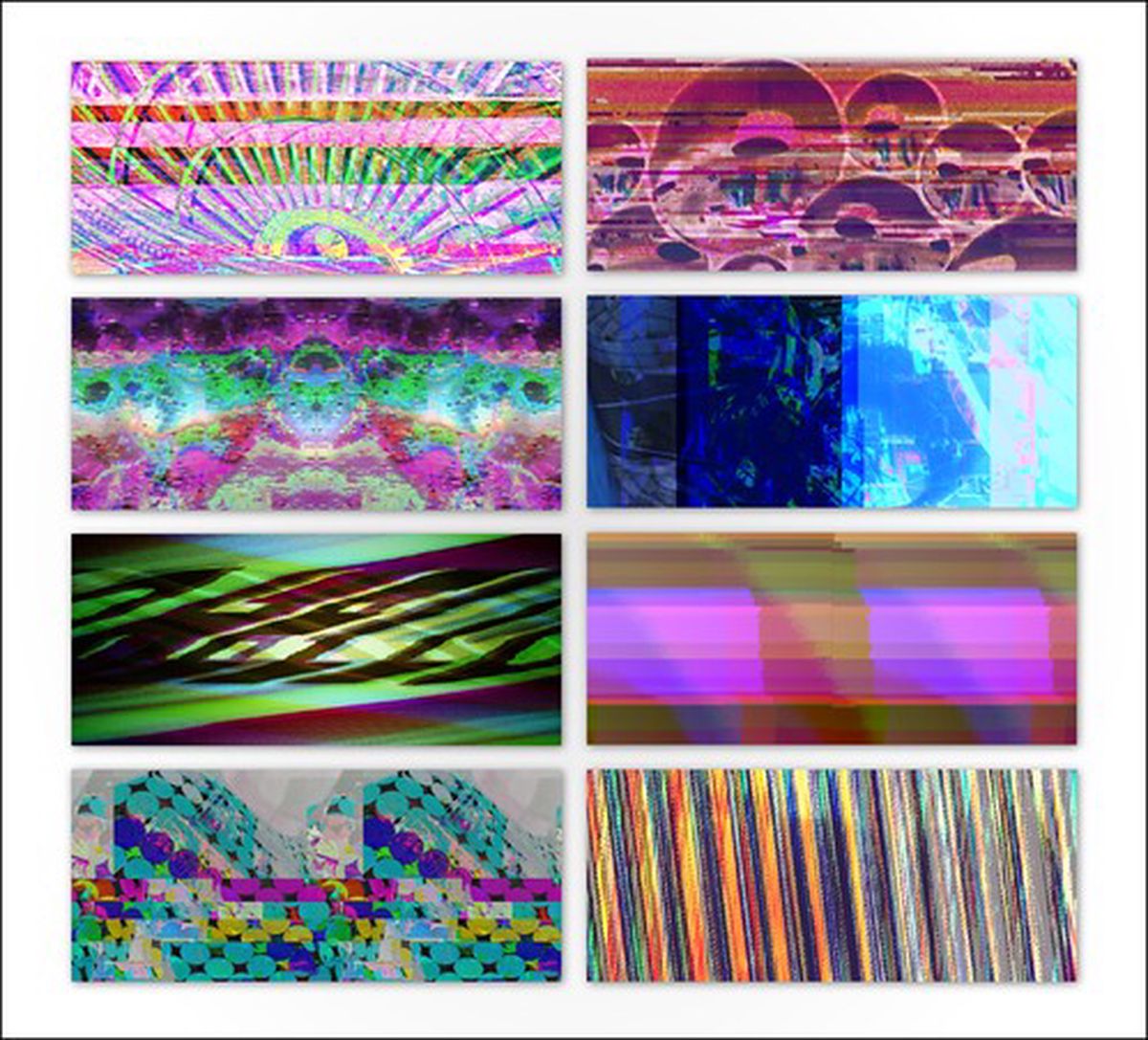
I’m not sure why, but I’ve never had business cards…. until now (sorta). I’ve just finished designing these eight:

Mini Cards (by hellocatfood)

As expected databending played a big part in their creation as did a bit of post processing. Time to get them printed!


Bull Glitch

You may have noticed that in my previous post there was a nice little image of the Bull Ring Bull. I did that! Before I go on, it’s not an image that will be used for Birmingham’s City of Culture bid (though if you really like it monies plz). It’s more an image just to represent the work that we’re doing to collect opinions of Birmingham.

bull glitch

Although not a completely original concept (Andy Warhol anyone?) I have utilised a few newly found techniques to create it. Whilst the results, and indeed databending as a whole looks cool I have yet to use it in any real world situations. Until now that is.


Databending using Audacity

Author's note — 17.09.2026

Audacity 4 was recently released to a lot of fanfare. However, it is not yet possible to use it for databending as it cannot import raw data. This has been added to their tasks but until it is implemented keep a copy of Audacity 3 on hand for glitching

Thanks to some help on the Audacity forum I finally know out how to use Audacity to databend. Previously I’d been using mhWavEdit, which has its limitations and just doesn’t feel as familiar as Audacity. From talk on the various databending discussion boards I found that people would often use tools like Cool Edit/Adobe Audition for their bends. Being on Linux and restricting myself to things that run natively (i.e. not under Wine) presented a new challenge. Part of my task was to replicate the methods others have found but under Linux. My ongoing quest is to find things that only Linux can do, which I’m sure I’ll find when I eventually figure out how to pipe data through one program into another!


Video conversion glitch

I made this video at a training day in using Macs/video editing software with children and community groups. I completed the task as asked but then switched to my laptop, fired up kdenlive and tried to see what it was capable of. It was upon exporting to ogg that I got a nice surprise.

Whilst this kind of glitch is rather nice one must be careful not to be reliant on it for production as at any time it could be fixed. Effects such as this Photoshop truncating glitch are now only possible in Photoshop 6 as the bug that caused it has been fixed. This is why I’m now more on the lookout for programs/scripts and guaranteed methods for reproducing glitch effects. The ones that tend to be best at this are ones that can import any data, an example of this being Audacity’s ability to attempt to load any file you load into it.


Bending a penguin

Awhile back I did a quick vector illustration of a penguin. It was nothing much really but as far as penguins go I quite liked this one. Recently (as in, the last four months) I’ve been interested in databending. Have you ever had an image you’ve taken come out like it’s been through a shredder? That’s the effect that most databenders are after. In a way it’s like trying to reproduce an error. Once you’ve done it a few times you get to learn what effects different methods can produce but even then it’s very unpredictable. For a short tutorial on databending an image, take a look at the one I wrote for fizzPOP.