tag: Tutorial

Controlling Improviz Using Midi via OSC

In 2020 I did quite a number of workshops in using the Improviz visuals live coding environment. Improviz can be thought of as a fork of Livecodelab, especially as its developer, Guy John, is one the developers of Livecodelab. However, it has some key differences that make it stand out as its own unique software:

  • It works on the desktop, and I think it is faster because of it
  • The language is more fully documented
  • You can load your own textures, gifs, 3D models, and shaders

Being able to load your own textures might in itself be a reason for many people to switch from Livecodelab to Improviz. Things can be that just a bit more personalised when you’re using your own images and objects rather than only colours, gradients and basic geometrical shapes. Another potentially useful difference is that in Improviz you can interface with the software using Open Sound Control (OSC). This opens up the possibility of using software or external hardware devices. In this blog post I’ll take you through how you can connect a midi controller to Improviz via OSC and Pure Data.
I Am Sitting in a Room Revisited

My remake of the Alvin Lucier artwork I Am Sitting in a Room was released 10 years ago today. To mark this occasion I want to revisit how I made it and troubles I had remaking it for 2019.

In November 2019 I Am Sitting in a Room was exhibited at Gamerz Festival in Aix-en-Provence in France. It was a pretty nice surprise to be invited to exhibit that piece, especially as it was made in 2010 and hasn’t been exhibited since aroudn 2015.


OCR to Text to Speech

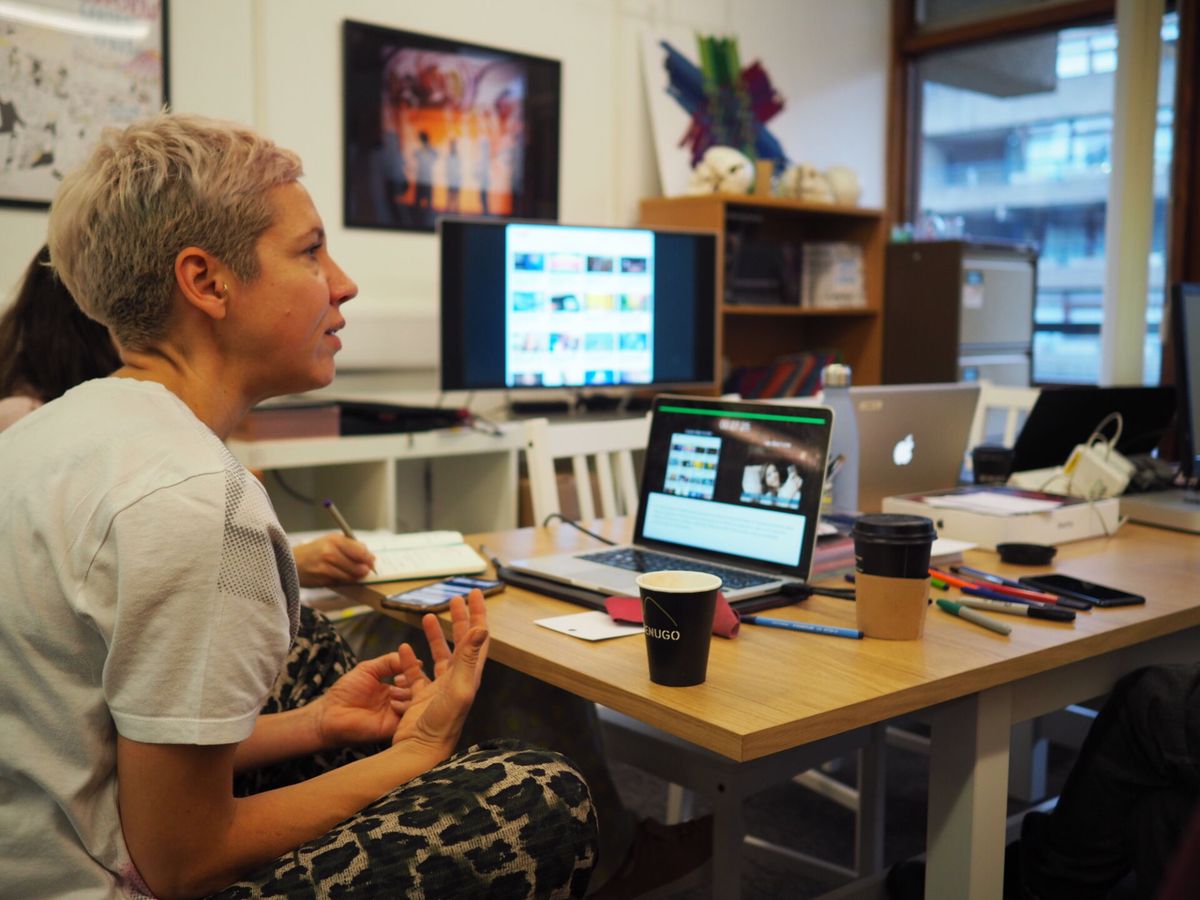
For the sixth video in the Design Yourself series the group worked with artist Erica Scourti. For the activity the participants used optical character recognition software (OCR) to generate poetry from their own handwriting and writing (leaflets, signage) found throughout the Barbican building.

OCR to Text to Speech

OCR to Text to Speech

OCR to Text to Speech

OCR to Text to Speech

The next stage in the workshop was going to be to take this extracted text and run it through a text to speech synthesizer, but unfortunately there wasn’t time to get to this stage.


Seamless Looping Neon Trail in Blender

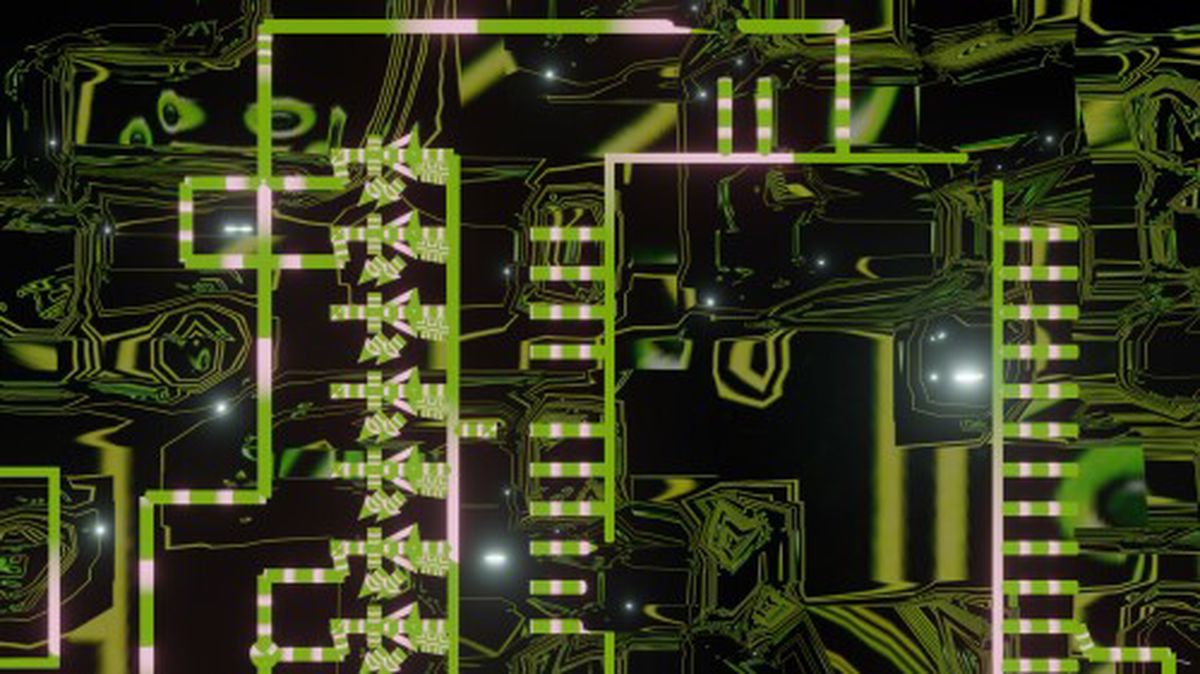
I’d like to return to the fifth video in the Design Yourself series to show how i did a glowing neon trail. The video is heavily themed around robots, and if you look in the background you’ll see that it’s actually a circuit board.

Seamless Looping Neon Trail in Blender

The circuit diagram was a random one I built using the rather excellent Fritzing software. If you’re ever looking for high quality SVG illustrations of electrical components then Fritzing is a great resource. I brought the exported SVG diagram into Blender to illustrate it a bit.


Seamlessly loop Wave Modifier in Blender

Seamless animation

For the Improviz gifs one of the requirements that Rumblesan set is that the gifs loop seamlessly. That is, one would not be able to tell where the gifs beings and ends. In Blender making an animation seamless is pretty easy. There’s lots of examples out there but for completion here’s my simple take on it.

With the default cube selected press I and then press on Location. This inserts a keyframe for the location (this menu can also be accessed in Object > Animation > Insert Keyframe). On the Timeline at the bottom move the animation 20 frames. Then, move the cube to somewhere else.


Overlaying multiple textures in Blender

In 2019 I made an internet artwork for Fermynwood’s programme Toggler.

Overlaying multiple textures in Blender

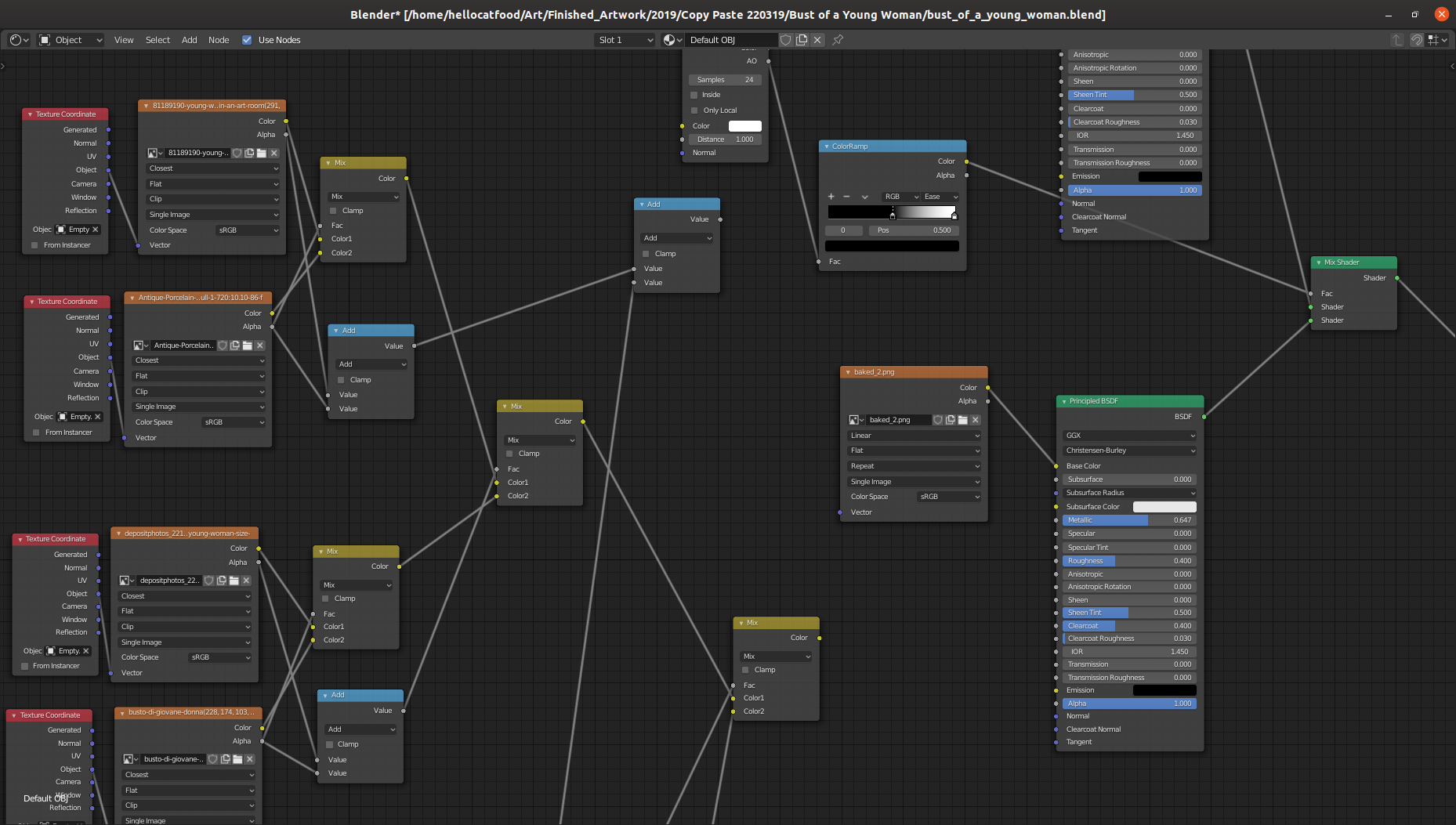
For this work I decided to use a similar aesthetic and process to Visually Similar. I talked a little bit about the process behind Visually Similar in a June’s Development Update. The node tree to overlay each of the transparent textures looked a bit like this.

Click to embiggen
Click to embiggen

When trying to do the same with the Toggler artwork I came across something weird that meant some textures just weren’t showing. So I decided to ask on Stack Exchange and Reddit why this might be the case.


Installing Bcc: at Vivid Projects part 3

In this final part of this three-part series I’ll be going over installing Xuan Ye’s work in the Bcc exhibition. This work posed a similar challenge to Scott Benesiinaabandan’s work. I needed to automatically load a web page except this time I needed to allow for user interaction via the mouse and keyboard.

The artwork isn’t online so I’ll again go over the basic premise. A web page is loaded that features a tiled graphic with faded captcha text on top of it. The user is asked to input the text and upon doing so is presented with a new tiled background image and new captcha. This process is repeated until the user decides to stop.


Installing Bcc: at Vivid Projects part 2

The next artwork that was challenging to install was Monuments: Psychic Landscapes by Scott Benesiinaabandan.

Bcc:

I won’t be showing the full artwork as all of the artworks were exclusive to Bcc: and it’s up to the artists whether they show it or not. On a visual level the basic premise of the artwork is that the viewer visits a web page which loads an artwork in the form of a Processing sketch. There is a statue in the centre which becomes obscured by lots of abstract shapes over time whilst an ambient soundtrack plays in the background. At whatever point the viewer chooses they can refresh the screen to clear all of the shapes, once again revealing the statue.


Installing Bcc: at Vivid Projects part 1

I took a bit of a break from writing the Development Updates. September was pretty busy with Bcc: (more on that below) and then I was completing a commission for Will’s Kitchen/The Shakespeare Birthplace Trust and preparing for my solo exhibition, We Are Your Friends.

With all of that now completed I’m writing a few posts about one project in particular: Bcc:

The Bcc: exhibition opened at Vivid Projects on Friday 6th September. It was a collaboration between Vancouver-based Decoy Magazine and Birmingham-based Vivid Projects. The exhibition featured a curated selection of works from Decoy Magazine’s online art subscription service called Bcc:. The basic premise is that each month you’d get specially commissioned art in your e-mail inbox.


Select objects of similar size in Inkscape

For the AlgoMech 2019 festival in June I created a new performative drawing piece, A Perfect Circle. The piece is about how we interface with computers that analyse our activities. It consists of a video and accompanying plotter drawings.

Making A Perfect Circle presented me with a few challenges. The make the video element I hacked together a couple of Processing scripts that did basic motion tracking by following a user-specified colour. It would draw these lines, creating new lines (instead of adding to an existing line) at each major turn and giving them a unique colour.


Typewriter text effect

For the Algorave at British Library in April I was asked to make a promotional video for it, which proved a difficult but for a very specific reason. I wanted to emphasise the liveness of live coding and show code being typed. For this I used the code supplied with Alex McLean aka Yaxu’s excellent Peak Cuts EP.

Typewriter text effect

The effect of having the text appear word-by-word or letter-by-letter is often called the typewriter text effect. I’ve previously written about how to do this in Pure Data/GEM. I needed to have a bit more control than what I got in PD, and I needed to export as transparent pngs so this solution wouldn’t work.


Convert Object texture coordinates to UV in Blender

Making digital art is quite a lengthy process and even moreso if you’re using non standard processes or making your own software. For awhile I’ve wanted to write about my processes and how I’ve overcome the bugs and problems. In what will hopefully be a regular series of blog posts I’m going to give a bit of insight into this process. In a way it’ll be a tutorial. Let’s go!


Five Days of Pure Data - Live Coding

In the years that I’ve been creating things in Pure Data I have amassed quite a collection of unfinished and messy patches. Over the last few days I have been releasing a few of these patches and techniques that I implement when programming in Pure Data.

Live Coding

The last tutorial isn’t that much about actually programming with Pure Data and is more about performing with it. More specifically, live coding. Live coding takes programming to a performative level. There’s been a lot of writing recently about Live Coding so take a look around. I’ve been programming live visuals for Pure Data since 2014 (a lot happened that year). It’s not without it’s problems, some of which I written about in the past.


Five Days of Pure Data - Stop Motion

In the years that I’ve been creating things in Pure Data I have amassed quite a collection of unfinished and messy patches. Over the next few days I’ll be releasing a few of these patches and techniques that I implement when programming in Pure Data.

Stop Motion

It was at the Co-Position meeting of the Libre Graphics Research Unit in 2012 that I first encountered Toonloop. It’s creator, Alexandre Quessy, gave a live performance using lights, Lego pieces and other objects. I was really quite in awe of how stop-motion was used to create quite an enjoyable performance.


Five Days of Pure Data - Infinite Scrolling

In the years that I’ve been creating things in Pure Data I have amassed quite a collection of unfinished and messy patches. Over the next few days I’ll be releasing a few of these patches and techniques that I implement when programming in Pure Data.

Infinite Scrolling

For a performance at ChipFest 10 in 2014 I wanted to recreate the look of a scrolling video game but within Pure Data. Sure, I could have just used a console emulator or recorded a clip and used that but doing it all within Pure Data allows me to have some more flexibility with how I perform. Here’s what I made:


Five Days of Pure Data - Randomise Text

In the years that I’ve been creating things in Pure Data I have amassed quite a collection of unfinished and messy patches. Over the next few days I’ll be releasing a few of these patches and techniques that I implement when programming in Pure Data.

Randomise Text

In the early 2010s I had quite an interest in zines. I had co-organised the Birmingham Zine Festival and was quite regularly reading this. As a result of this in 2011 I started collaborating with a friend, Rebecca Evans, on a collaborative zine. The concept is that we would interpret each others’ way of working using our regularly used tools. Rebecca specialises in textiles and has quite a skill at crocheting, amongst other things. I, on the other hand, can barely operate a sewing machine and feel much more at home using a soldering iron or computer.


Five Days of Pure Data - Image to Signal

In the years that I’ve been creating things in Pure Data I have amassed quite a collection of unfinished and messy patches. Over the next few days I’ll be releasing a few of these patches and techniques that I implement when programming in Pure Data.

Image to Signal

If you’re into experimental ways of creating visuals and happened to be on the internet around 2013 you have have been sent information about software called PixiVisor. The software, developed by Alexander Zoloto, allows one to transmit an image via an audio signal to another device which decodes it and displays it as an image. In this way you can then apply audio effects to the signal and make some pretty cool visuals. I never tried it myself but was quite impressed by what I saw.


Pure Data Patching Circles at BOM

From 16th March to 27th April I ran a four part Pure Data Patching Circle at Birmingham Open Media. It was originally intended to be an informal gathering of Pure Data and “creative coding” enthusiasts but quickly it turned into a course in using Pure Data. Here’s some of what I learnt from running it.

Patching Circle #1

This was an almost exact replication of the beginner’s Pure Data workshops that I’ve done in the past at places such as GLI.TC/H 2012, Vivid Projects and Flip Festival. I first introduced some of the projects that I have done and then dove straight into things like installing the software on different platforms.


Pure Data File Killer

On one of my frequent journeys on the information superhighway I stumbled across Little-Scale’s Mass JPG Killer. This handy little patch allows a user to load any binary file and “glitch” it by overwriting some of the original data with a repeating pattern of user-defined data.

Mass JPG Killer by Little-Scale

The only problem (for me and people like me) is that I don’t have Max/MSP and can’t install it on Linux, meaning I’ve never actually used it!


Glitch Webcam

Glitch Webcam* is a small script that was developed during my time at Databit.me as part of the Open Camera project, which aimed at finding inexpensive ways to take images. Since then it has been in the MEMIC exhibition in November 2012 and usually makes an appearance wherever my laptop goes.

At only five lines of code and ~254 bytes, this script is a very quick way to glitch photos taken automatically by a webcam. The project was originally demoed using a Raspberry Pi/Raspbian and a digital photo frame, though problems with USB have prevented me from doing that since.


Create your own glitch typeface

Making Dataface was really quite an exciting journey. What started off as an attempt to make a typeface inspired by glitch art turned out to be a story of collaboration, exploration and hours of research. Here, I will go through my process.

As you may have seen from my previous experiments in vector databending it’s totally possible to manipulate vector files. My original method for creating Dataface was to save each glyph in the Liberation font to an SVG file and then go through the process of glitching it for each file. Obviously this would’ve taken me a long time, hence why there was very little activity between my original announcement in January and when I started work on it again a few weeks ago.


Bending a penguin

Awhile back I did a quick vector illustration of a penguin. It was nothing much really but as far as penguins go I quite liked this one. Recently (as in, the last four months) I’ve been interested in databending. Have you ever had an image you’ve taken come out like it’s been through a shredder? That’s the effect that most databenders are after. In a way it’s like trying to reproduce an error. Once you’ve done it a few times you get to learn what effects different methods can produce but even then it’s very unpredictable. For a short tutorial on databending an image, take a look at the one I wrote for fizzPOP.


Blending Inkscape and Blender

One of the things I’ve always wanted to do is to work on an image in a 3D environment but then export the resultant image to an svg. Being the open source nut that I am my main weapons of choice are Blender for 3D work and Inkscape for vector. These programs have their advantages and their disadvantages. The main advantage they have over many similar programs is that they’re open source and free. They’re very capable products and are used quite widely and are being actively developed. In fact, Inkscape is getting ready to release version 0.47 (I’ve used a prerelease and it’s awesome)