Blender Wont Save You
Author's note — 16/08/26
Sometimes my activities in open source land don’t involve programming. Occasionally I write tutorials or frequent software forums and try and help other people. One forum that I’m occasionally on is the Natron forum. For those that don’t know Natron:
Natron is a free and open-source node-based compositing software application. It has been influenced by digital compositing software such as Avid Media Illusion, Apple Shake, Blackmagic Fusion, Autodesk Flame and Nuke, from which its user interface and many of its concepts are derived.
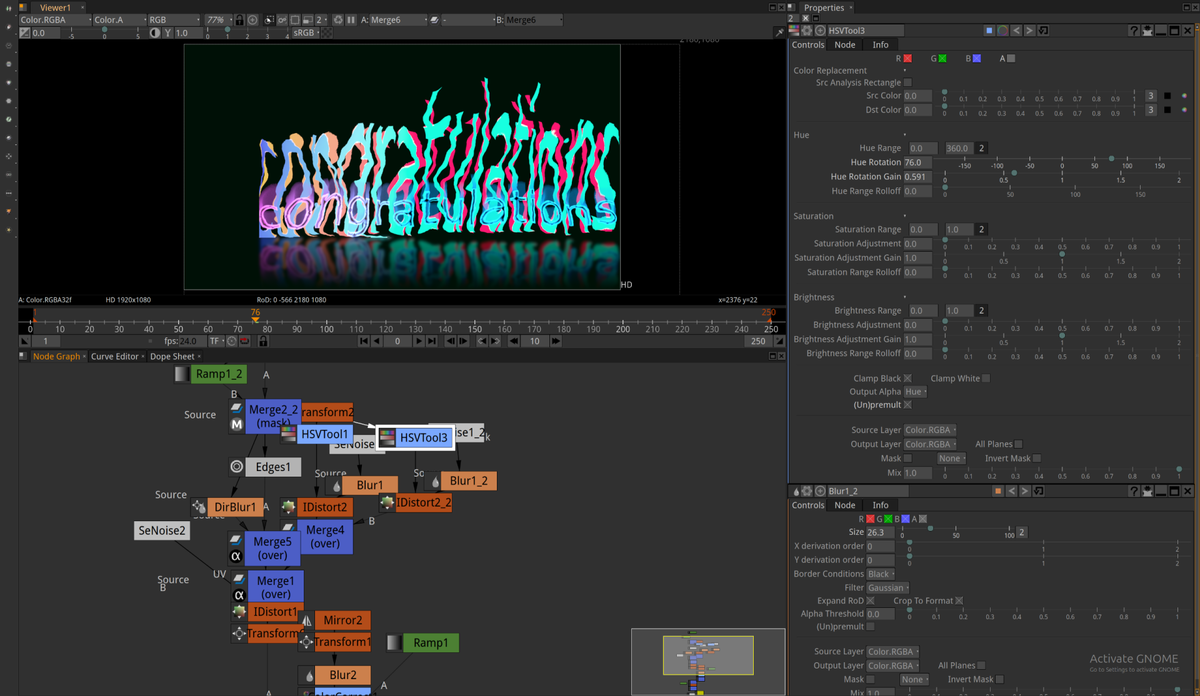
I’ve used it in artworks such as Basiquat’s Brain, the Re-Animation projections I created for Barber Collective, and the recent videos I’ve been creating with Barbican Young Creatives.
Unfortunately since 2018 it has been left mostly unmaintained as the primary developers left the project. Libre Graphics World has a really good interview with one of it’s developers which goes into this in more depth.
The need for developers is not unique to Natron. There are a few success stories where an open source software project has secured enough developers for it to keep going. Some of the best examples of this would be the Linux kernel, Ubuntu and Android. Each of these has a mixture of volunteer and paid developers.
Author's note — 16/08/26
The story is different when concerning open source graphic design and creative software. To my knowledge the biggest success story is Blender. Since it first appeared in 1998 the software now boasts a number of paid full time developers (though certainly not equal to the amount that Autodesk has), their own offices, commercial sponsors, and a foundation that supports the development of Blender and it’s connected activities. It would seem like common sense for anyone to suggest that a troubled project attempt to mimic Blender’s path to success or even reach out to them for help, either in the form of developers or funding. It’s the latter of these suggestions which I see regularly and want to address here.
After seeing this suggestion of approaching Blender for support yet again on the Natron forum I decided to reach out to Ton Rooendaal, the founder of Blender, for an answer. I regularly delete my tweets so I’m providing a screenshot below and a link to Ton’s response.
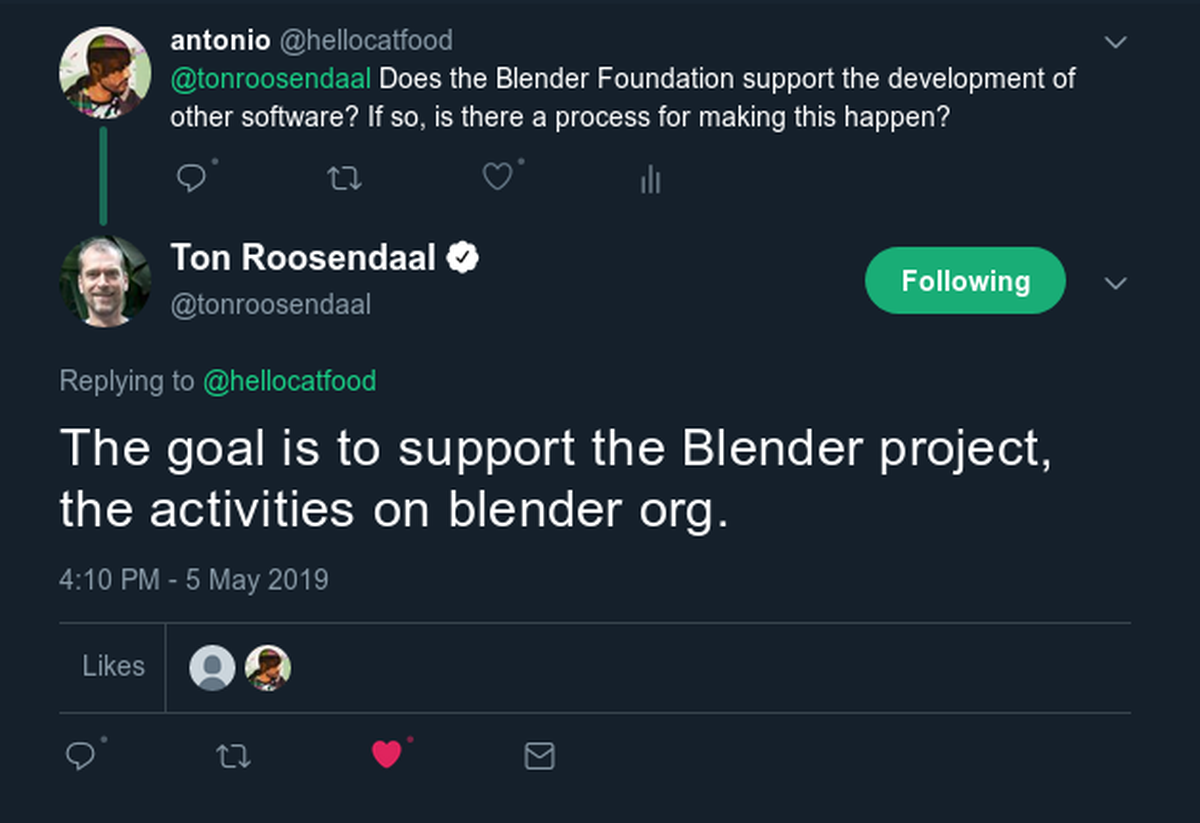
His answer wasn’t a clear cut “no” but it does heavily imply that Blender dosen’t support the development of other software either financially or by lending a project some of its developers. This is further backed up by reading the Blender Foundation’s goals:
- Manage the facilities on blender.org for users and developers who want to contribute to Blender.
- Maintain and improve the current Blender product via a public accessible source code system under the GNU General Public License.
- Establish funding or revenue mechanisms that serve the foundation’s goals and cover the foundation’s expenses.
- Provide individual artists and small teams with a complete, free and open source 3D creation pipeline.
Blender may indirectly support the development of other software through improving shared libraries which it uses, but again, afaict it doesn’t directly support other projects.
Now, those suggesting that a project asks Blender for support are certainly well-intentioned, but their efforts may be better spent finding organisations who actually do have it in their mission statements or goals to help support the development of open source software projects in some way. Here’s a few that I’ve found with a bit of research:
Google Summer of Code
Google Summer of Code is a global program focused on bringing more student developers into open source software development. Students work with an open source organization on a 3 month programming project during their break from school.
Many projects have benefited from this programme since it started in 2005.
ASIFA-Hollywood
As part of our mission to promote the art and industry of animation, ASIFA-Hollywood intends to be a strong voice for the development of open source software. Over the last few decades, there have been incredible advancements in the quality of open source software solutions for artists. Although historically, complex 3D rendering tools and animation software have had a high upfront cost barrier, open source software development is more than ever serving as a counterweight to put fantastic technology in the hands of anyone who is curious enough to explore it.
ASIFA-Hollywood has supported several opens source projects, including Synfig who in 2018 received $2000.
Shuttleworth Foundation
Twice a year we award a number of small grants to a collection of social change agents, no strings attached, in support of their work. We call these Flash Grants and recipients are selected based on nominations from our Fellows. Each award is worth $5,000.
In 2013 Synfig received one such flash grant. It would appear that there is no application procese and instead people/projects are nominated.
Epic Megagrants
Epic Games has committed $100 million to support game developers, enterprise professionals, media and entertainment creators, students, educators, and tool developers doing amazing things with Unreal Engine or enhancing open-source capabilities for the 3D graphics community. Show us your projects and you could earn a financial grant to help fuel your success.
Blender recently received one of these Megagrants. It seems to have a focus on 3D content creation so many not all software is eligible.
There are probably more funding programmes but I’m not aware of them.
Outside of this route crowdfunding through Patreon, Ko-Fi or other methods is a popular option. Projects such as Synfig, Olive, Godot, Krita and Ardour each have active crowd funding campaigns (i.e. not just Donate buttons) that support the development of the general software or are helping to reach specific goals.
Some individual developers run their own crowd funding campaigns. For example GIMP doesn’t have a legal entity that accepts donations and instead relies on the GNOME Foundation for collecting donations. They also actively encourage contributors to run their own funding campaigns. Two such examples are Øyvind Kolås and Jehan Pagès who both actively contribute to GIMP. This approach can also be seen in Inkscape where two active developers, Marc Jean Mougin and Tavmjong Bah both have crowd funding campaigns.
Can’t Someone Else Do It

So now that you’ve told a failing project to write to ASIFA or set up a Patreon the problem is solved, right? Well, no. Becoming a skilled programmer can take many many years and is a demanding career in itself. Is it really fair to also expect these same programmers to also be skilled in writing funding applications, setting up successful crowd funding campaigns, be good at communicating (e.g. regular development update blog posts), writing extensive high quality documentation and all the other things which projects like Blender seems to be so good at? A successful open source software project can’t really exist as a single-person operation. It needs a team of people to take on the many and varied jobs.
In the case of Natron it seems that right now those jobs are open for anyone to do!
More generally, though, If you have an idea on how a project could get additional support, and are passionate about seeing it through, then consider volunteering yourself to implement it. It won’t be a quick fix but in the long run it’ll benefit the project and all those who use the software.