Tableaux consists of twelve events over three weeks with over one hundred contributors exploring various themes. Assembly Point has invited organisations and individuals to coordinate each event resulting in a diverse and exhilarating programme of moving image and performance.
Synthetic Resonances will showcase a selection of moving image work (videos and GIFS) from artists that use digital tools in order to fabricate environments that can act as a rhizomatic structure of synthetic mediations in terms of ambience, materiality, construction.
Featuring work by: Morehshin Allayari, Alma Aloro, Anthony Antonellis, LaTurbo Avedon, Iain Ball, Masha Batsea, Andrew Benson, Gabby Cepeda, Jennifer Chan, Georgios Cherouvim, Di-Andre Caprice Davis, Stine Deja, Adam Ferriss, Carla Gannis, Carrie Gates, Roxanne Gatt, Emilie Gervais, Claudia Hart, Faith Holland, Georges Jacotey, Nicole Killian, Gergo Kovacs, Rollin Leonard, Sara Ludy, Rea McNamara, Joe Melhuish, Martina Menegon, Rosa Menkman, A.Bill Miller, Lorna Mills, Kimmo Modig, Pussykrew, Charlotte Maeva Perret, Haydi Roket, Sam Rolfes, Antonio Roberts, Hirad Sab, Sucuk and Bratwurst, Alfredo Salazar-Caro, Rick Silva, Yoshi Sodeoka, Tristan Stevens, Valinia Svoronou, Michaël Systaime Borras, Katie Torn, Dalena Tran,Theo Triantafyllidis, V5MT with music by CELESTIAL TRAX, Miyo Van Stenis, Johnny Woods, Matteo Zamagni, Giselle Zatonyl, Erik H Zepka
Permission Taken, which exhibited at Birmingham Open Media and University of Birmingham between October 2015 - May 2016, focused on copyright, remix culture and ideas around sharing, originality and ownership. In planning the exhibition I was fully aware that these concepts can be quite complex to comprehend and, worse still, incredibly boring, so I devised various ways communicate these ideas . I did so not in order to dumb it down but to give audiences as many entry points as possible. The exhibition featured images, texts, videos, sculptures, documentation of research and workshops. One such workshop was the Exquisite Corpse workshops.
It’s highly likely that you will have encountered the Exquisite Corpse idea before but under a different name such as Picture Consequences or Exquisite Cadaver. The concept was originally developed by the Surrealists in the early 1900s as a way to collaboratively create a piece of art. Having discussed this concept with David Littler whilst at the Fermynwoods Contemporary Arts Copyright + Art event I began to think about how this could be recontextualised to talk about ownership and copyright.
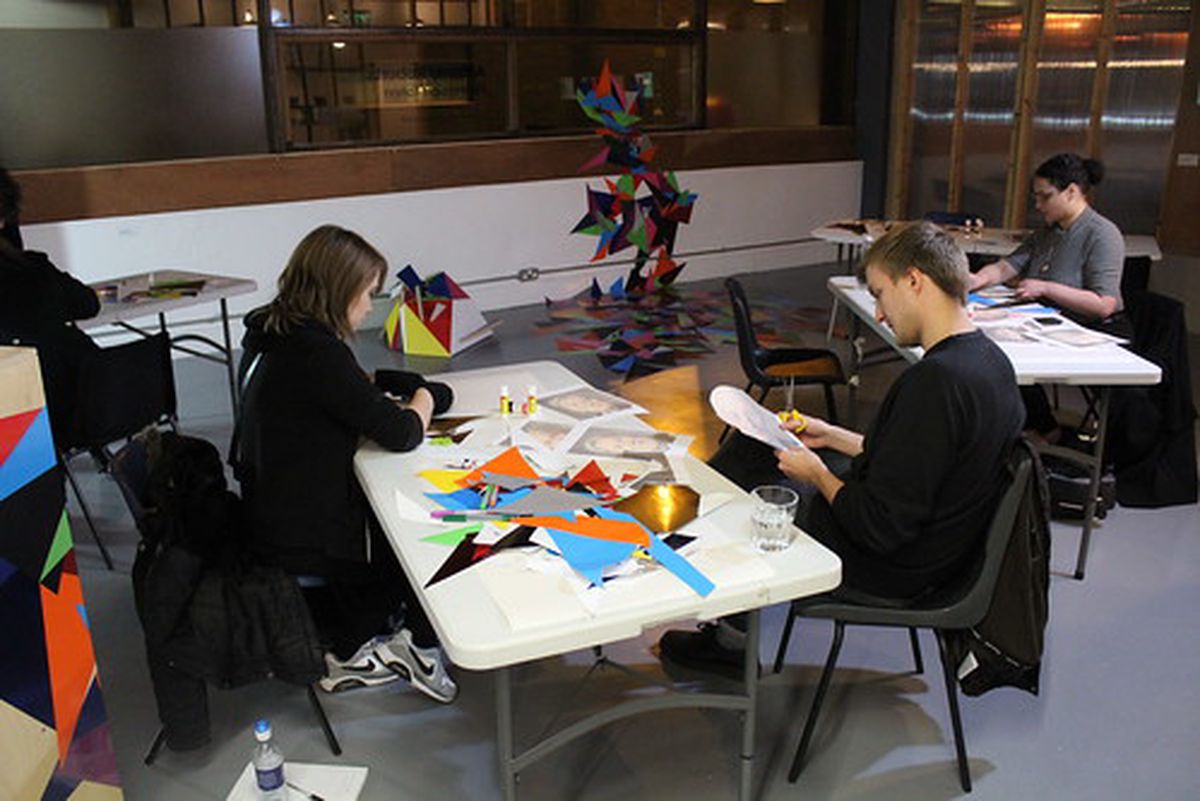
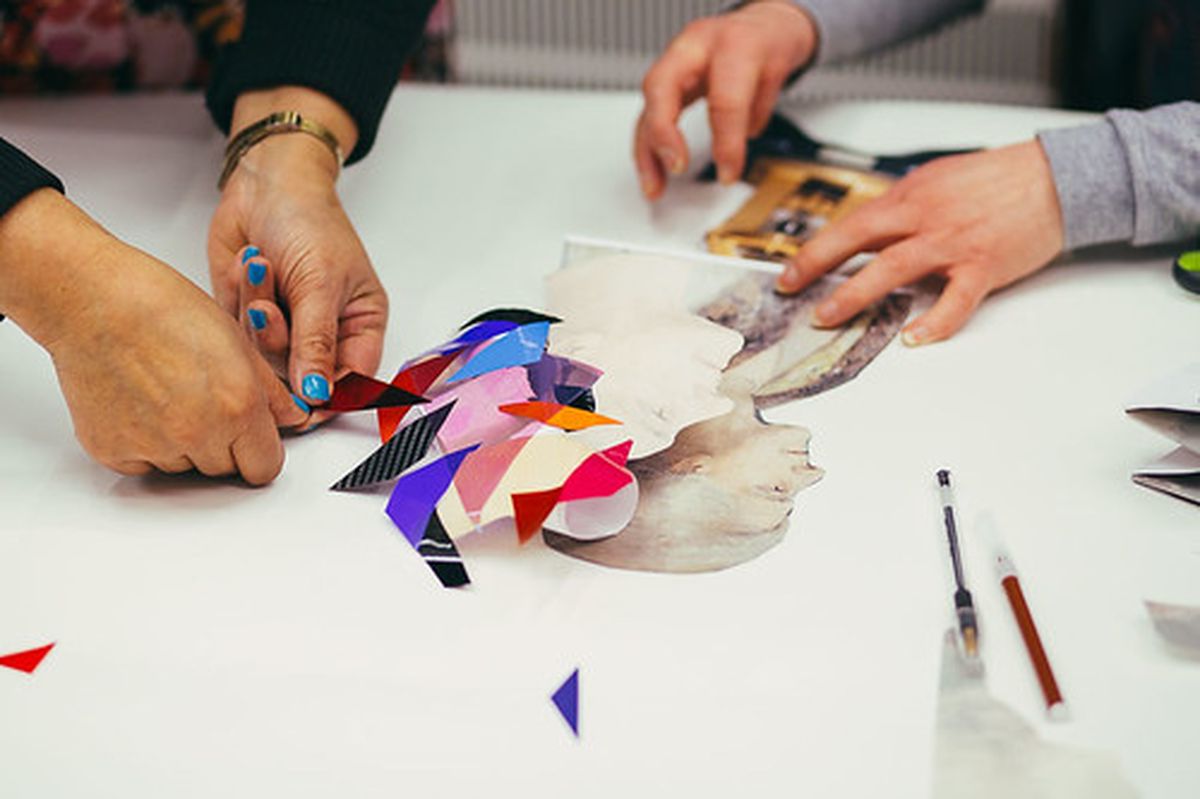
In the workshops, which took place at Birmingham Open Media and University of Birmingham as part of the Arts and Science Festival, I split the participants into small groups and gave them the task of creating an image based on a theme - children’s cartoons or mythical creatures. The tools they had at their disposal were images from the University of Birmingham’s Research and Cultural Collections, lots of small bits of vinyl and pens. In both cases artistic talent wasn’t the focus, more the communication of the theme. After a short time I made the groups switch places and add to the new piece using their theme i.e. not adopt the original theme.
Following the collaborative art making we regrouped to have a discussion about several topics. Imagining myself as an art dealer will lots of cold hard cash to spend (I wish!) I asked the group how the funds should be divided if sold. Initially most were more than happy to split it equally. That is until I decided to introduce some doubt.
I suggested to the group that the amount of funds given should be based on the quantity of their contribution. In planning the workshops I specifically gave each group less time on their second piece than I did on their first, the theory being that with less time they would be able to contribute less. Should this result in them receiving less funds?
I then suggested to them to think about the quality of the contribution and not just the quantity. One group used the imagined scenario that they were a highly successful artist and the others were still unknown. Even if the unknown artists contributed the same or more to each piece should the successful artist receive a greater share of the funds? Socially their contribution could be considered worth more due to their status and so, in theory, this could be reflected in the funds received.
Finally, they took into account whether the originator of the idea should be rewarded with a greater share of the funds. Although I was technically the originator of the idea of this iteration of the workshop, in each group you could see participants leading or guiding others using their own ideas. Using this line of thinking should the “originator " of the idea receive a greater share of the funds?
All of these ideas and more were discussed at length. The participants began to see how this relates to their own practice as they often collaborate with others and consider how it will affect the market value of their artworks and themselves. There are still no obvious answers to these questions and it often boils down to opinions and lawyers, of which there are many! For related things see Writing About Comics and Copyright by Ronan Deazley, which looks at quantity and quality in relation to copyright, the Sweat of the Brow doctrine which talks about effort in relation to the worth of art, and the Monkey Selfie which highlights authorship and ownership of art.
In the end what these workshops showed is that the legal side of art can distract from the creative aspects of it and make collaboration with others something more akin to a strict negotiation process. Nina Paley is an artist I often cite for her talk in which she talks about how copyright affected her work, Sita Sings the Blues.
Although my thoughts do mirror those of Paley’s, I am not advocating for a dismissal or abolition of the copyright system. Instead I would like to see the adoption of more permissive licences such as the Creative Commons licences and a greater focus on encouraging sharing and collaboration.
Author's note — 16/08/26
I cited Nina Paley’s work long before her transphobic views were publicly known or widespread. Of course I would not cite her or her work in anything today. And just so there is no doubt about my views on this: Trans men are men, trans women are women.
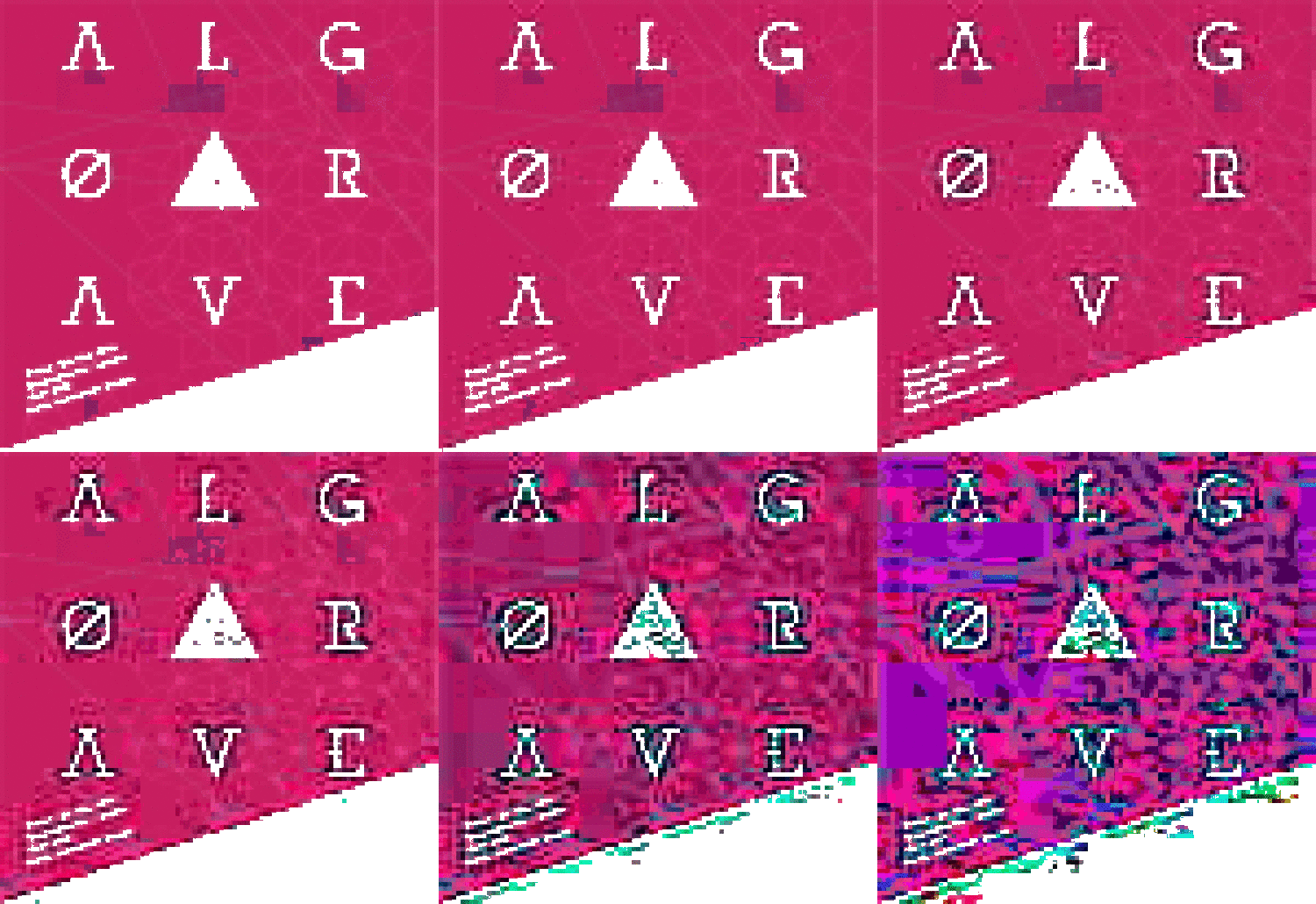
On Friday, May 6th 2016 from 6-11pm Ravensbourne’s new BA Design & Coding course is happy to sponsor the first Algorave@Rave, an audiovisual concert featuring live performers from across the world who elevate coding to an art.
Experimental, algorithm-aided, genre-misled, live-coded sound and visuals from the future coming to life before your eyes; bleeps, crashes, warts and all. Algorave is punk music of the next generation.
The lineup includes RGGTRN, Sam Aaron, Alexandra Cárdenas, Canute and Benoit and the Mandelbrots.
Tickets are just £3.50 and can be [bought from here](http://look of disapproval).
The lineup is rather similar and features the likes of Benoit and the Mandelbrots, Joanne, UIAESK!, and yaxu together with visuals from myself and chez.io. Tickets are only £6.47!