Blog

Pixel Player

Back in June 2014 I wrote how that in 2013, after visiting The Cyborg Foundation in Barcelona, I became interested in exploring sonification. My experients at that stage culminated in the production of the Pixel Waves Pure Data patch, which allows the sonification of images based on the colour/RGB values of individual ppixels.

I spent the following months building and refining an update to the Pixel Waves software, with a focus on allowing multiple images to be played simultaneously. In a way, I wanted to create a sequencer but for images. After many months I’m happy to formally announce the release of the Pixel Player.
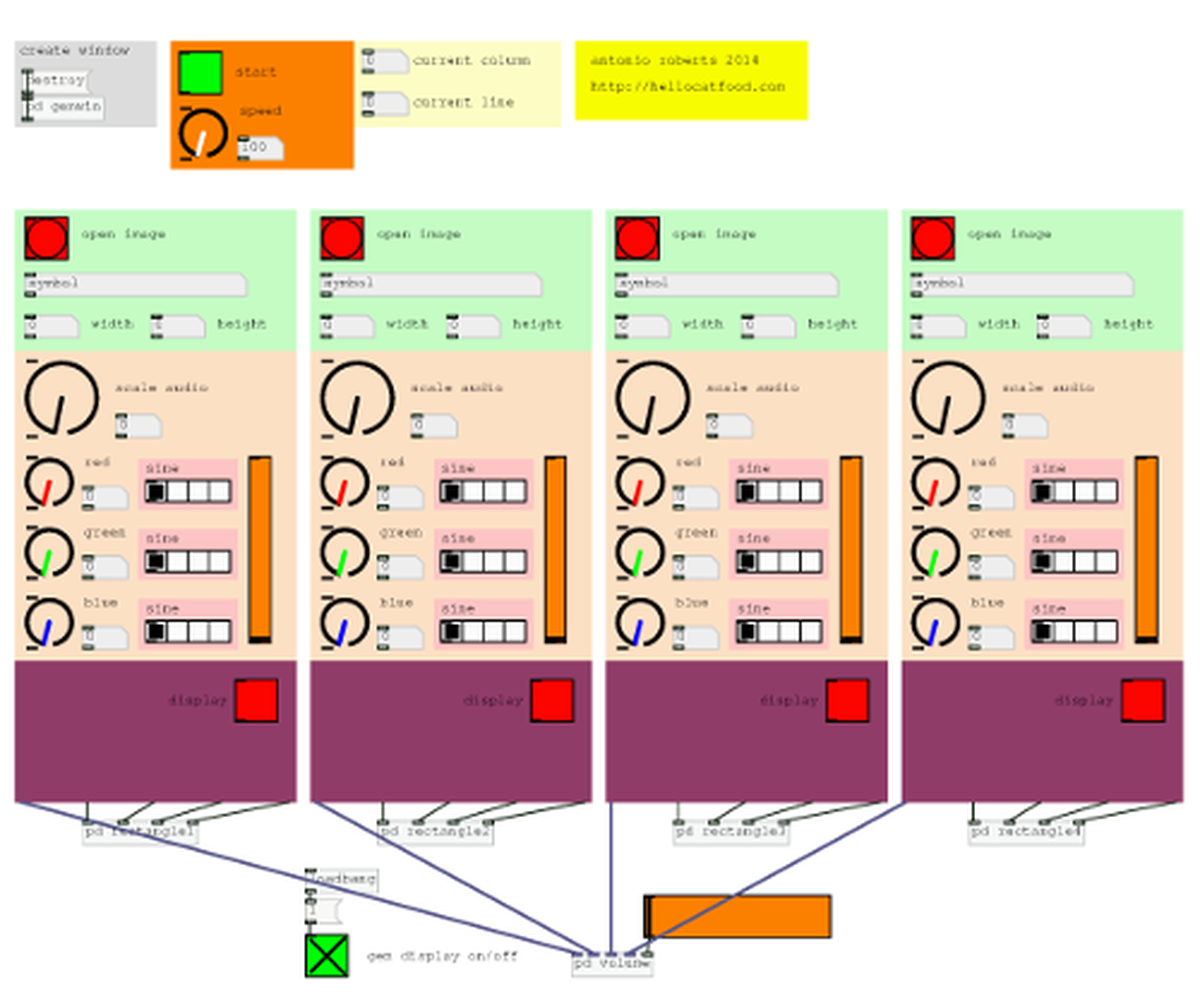
pixelplayer

This software operates in a similar way to Pixel Waves, but with a focus on playing multiple images simultaneiously. Instructions on getting started:

  • Create the GEM window
  • Click on the red button to load an image. Supported file types depend on your operating system, but generally jpg, gif and png file formats are supported
  • Click on the green start button and the pixels will start to be read
  • Drag the orange horizontal slider up to increase the master volume
  • Drag the orange vertical slider up on each pixel player to control its volume
  • Turn the knob to scale the pitch of the audio

The currently displayed/sonified pixel for each channel will be synchronised from the first channel. For this reason it is recommended that all of the input images used are the same dimensions.

This may sound like a lot to do but it becomes easy after a few attempts. To make things easier the loadimage.pd patch has inlets that you can use to control each channel with a midi controller, keyboard, or any other device. To expose the inlets increase the canvas size of the patch by around 10 pixels.

The software includes a video display output, which shows the current pixel colour. This can also be shown on the patch window by clicking the red display button. Flashing lights might not be to everyone’s taste, so this can be turned off. Due to this patch relying on [pix_data], the GEM window needs to be created, even if the pixel display isn’t used.

Enough yapping, what does it actually sound like?! Here’s a small demo, made using a combination of 40x20 images made in Inkscape and images modified using the Combine script by James Allen Munsch (made for Archive Remix. Remember that project?).

Please do give the patch a try and let me know what you think!

Sonification Studies

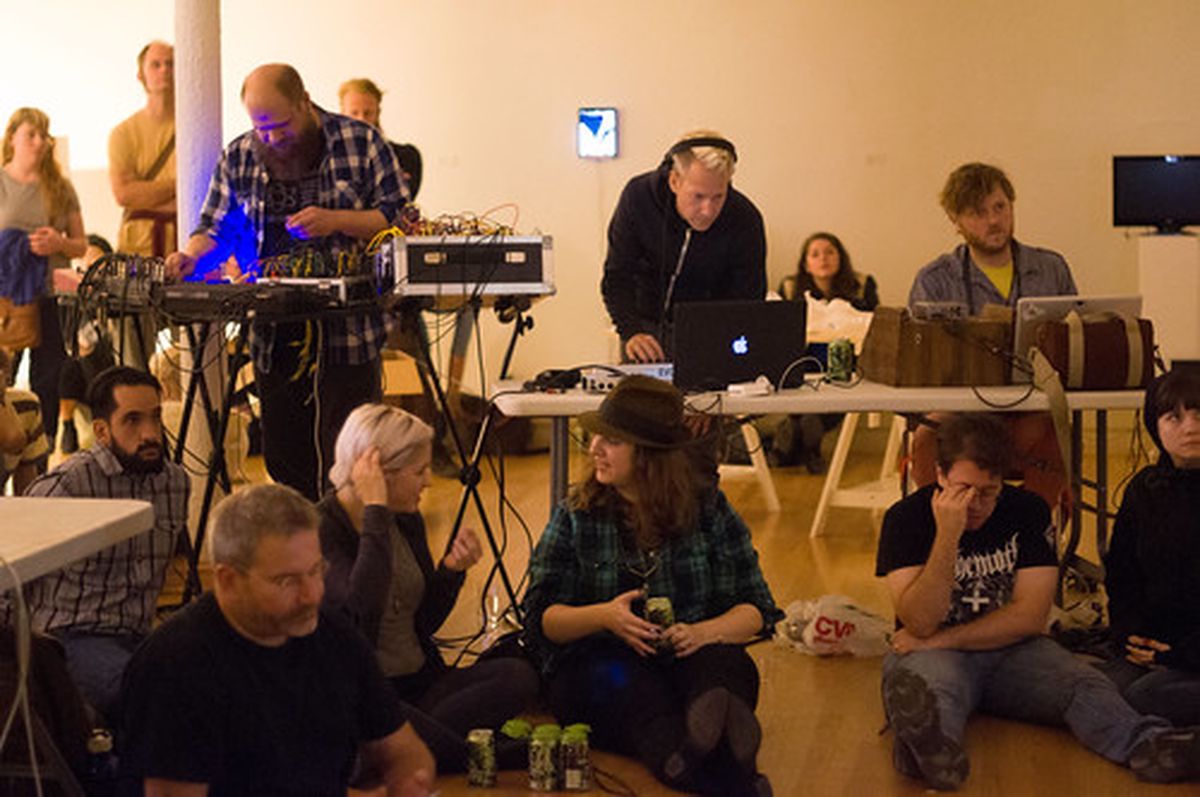
On 19th September I did a Sonification Studies performance at glitChicago. I had previously done a demonstration/performance of this at Relearn in Brussels, Post-Modern Plant Life in Leamington Spa, and at September’s Digbeth First Friday at Vivid Projects, but the glitChicago was what I consider to be the first proper performance. A culmination of my reserach, if you will.

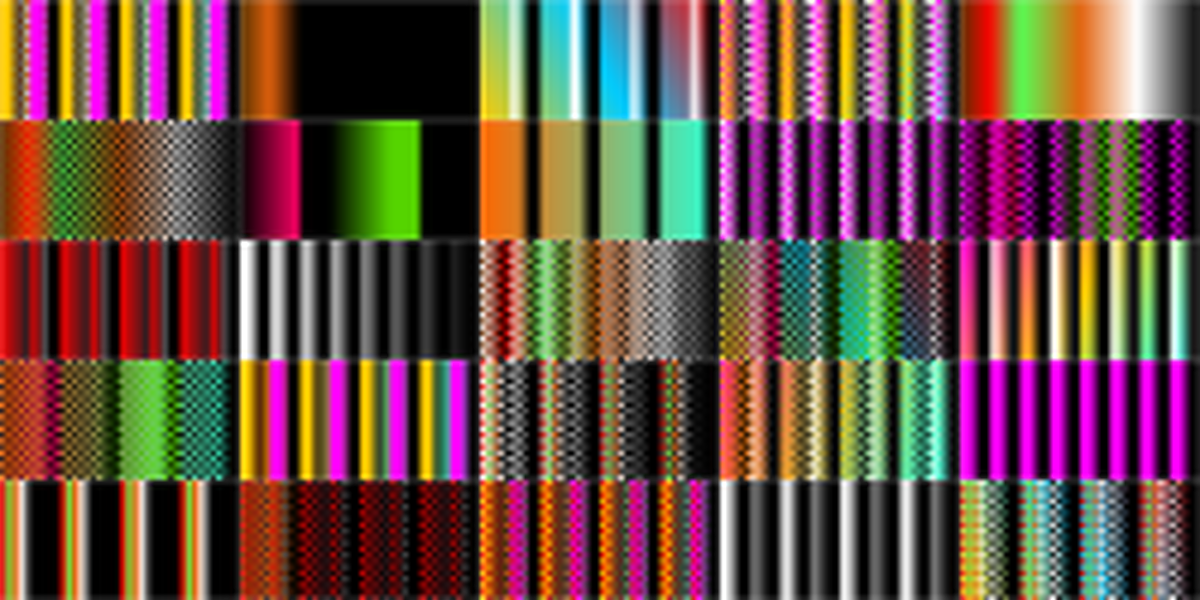
The focus for me at this performance was to get a sense of rhythm. Previous performances experimented with using found image sources, which resulted in a somewhat chaotic performance. For the glitChicago performance I composed a series of images with repeating patterns.

pixelplayergrid

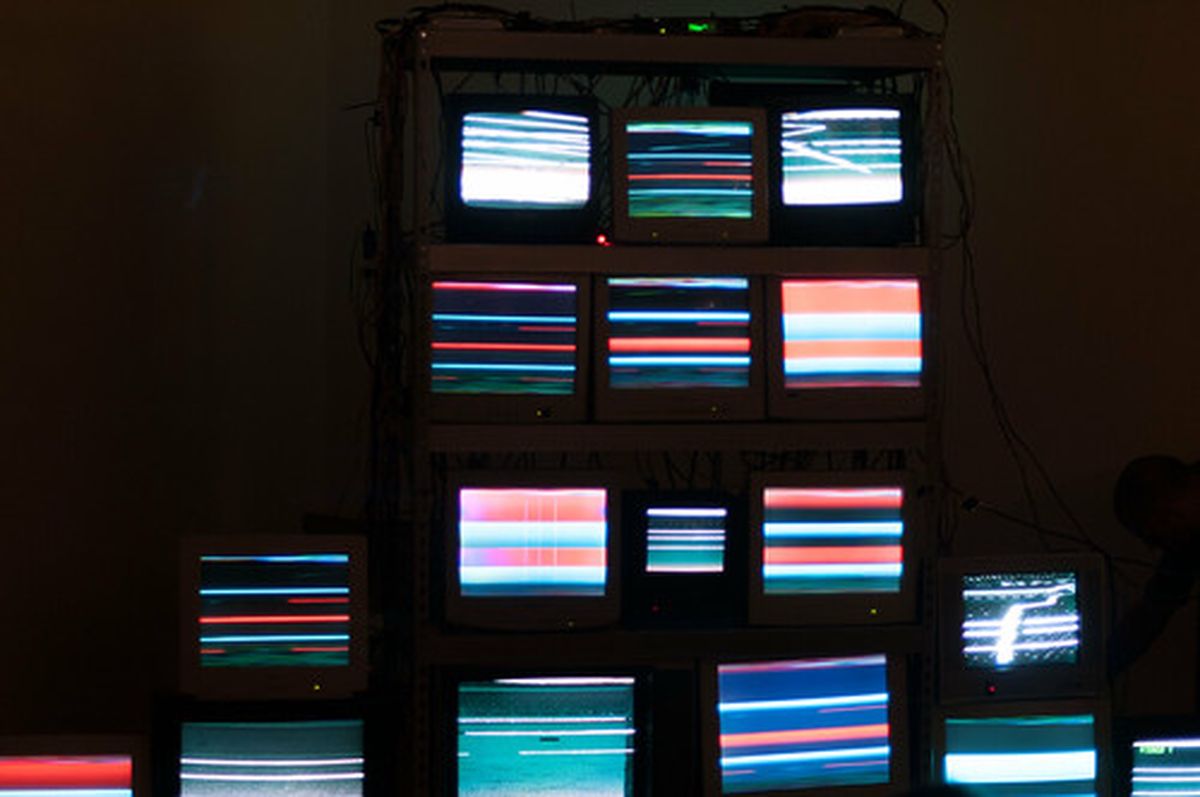
I separated these images into four groups, one for each channel. There were no rules strict for what went into each group, but I thought about which would sound better as beats, which have similar colours etc. A Bill Miller shot a bit of my performance, but bow that I’m back in the UK with all my equipment (actually just a midi controller) I present to you a remake of my performance. Warning: it’s loud and there be flashing images.

I’d be really interested to see and hear what others make with the software, or they take the code and extend it somehow.


glitChicago

I’m back in the UK after an amazing week teaching/guest lecturing at SAIC and performing at glitChicago. It was really great to see my friends and peers again, and to spread my knowledge and experiences of glitch art, new media art, and digital art as a whole. Enough yapping, here’s some photos from the exhibition by Paul Hertz:

glitchicago_140919_098

glitchicago_140919_003

glitchicago_140919_029

glitchicago_140919_040

glitchicago_140919_062

A Bill Miller shot an overview video of most of the performances:

And he also shot a bit of my Sonification Studies performance:

The attentive amongst you may remember that I’ve been exploring sonification a lot recently. With this performance now completed I will soon write up my research and formally present the Pixel Player software that I wrote so that you may explore this area yourself.

Much <3’s go out to Paul Hertz, SAIC, jonCates, everyone that participated in glitChicago, everyone that didn’t and my friends for bringing me back to Chicago and generally supporting my work ^_^


GIF Free For All

In early September I participated in the GIF Free For All online ehxibition, launched in conjunction with Computer Art Congress 4 - CAC4 Rio de Janeiro, and curated by A. Bill Miller. More info:

Animated GIFs can be created by anyone and are about anything. The animated GIF is ubiquitous and democratic. Online, it’s proliferation coincides with the developing ways we use the Internet. As a unique and accessible moving image filetype, animated GIF functions on the logic of openness and distributed networks in a time of increasing data surveillance and restrictions to access by governing bodies and corporate capitalization of data-spaces.

GIF Free For All is an online exhibition of animated GIFs created by 19 international artists. By acknowledging the range of contemporary and popular culture uses, this exhibition seeks to expand the conversation surrounding animated GIFs within Art contexts. By occupying server spaces worldwide, by circulating endlessly, by evolving and shifting over time, by looping and tiling in expanding frames and windows, the animated GIF is FREE FOR ALL.

For this I created two new gifs which make use of the [tof/animate] object in Pure Data and Inkscape:

hello

goodbye Whitney Kimball of Art F City described my gifs as “a joke that you don’t get unless you watch both GIFs and read their file names”. Thanks!

Click through to see the gifs from the other 18 artists.