We’re a group of people from England’s North (from Birmingham up) making music and art from algorithms, shared here in solidarity with the Black Lives Matter movement.
We join calls for justice for George Floyd and Breonna Taylor, but also reflect on the situation here in the UK, including the lack of justice for Stephen Lawrence, for Christopher Alder, for the people lost in the New Cross and Grenfell fires, for the Windrush deportees and all suffering under our government’s ‘hostile environment’ policy.
We want educational reform, so that the next generation can open their eyes to Black British history. Stating that ‘Black Lives Matter’ should not be difficult, but right now it’s not enough to be non-racist. We need to be anti-racist.
We share this compilation on a ‘pay as you feel’ basis, but please give generously if you can. All proceeds will go to Young Minds Together, a group of Black girls making music and dance in Rotherham UK, in need of your help to rebuild post-pandemic.
Peer to Peer: UK/HK is a digital programme and platform encouraging meaningful cultural exchange and forging enduring partnerships between the UK and Hong Kong’s visual arts sectors.
The programme launches with an online festival of international exchange and collaboration taking place 11-14 November.
The Festival will include an online exhibition of digital artworks from UK and Hong Kong based artists, including 5 new commissions by artists nominated by UK and Hong Kong based partners. There will also be a series of digital residencies taking place across partner organisation’s social media channels as well as a set of curated panel discussions.
In the spirit of exchange and collaboration the Festival is piloting a distributed leadership model, involving co-curation and co-production with partner organisations.
The project has been generously supported by funding from Arts Council England and the GREAT campaign.
I’m one of the five commissioned artists, alongside Danielle Brathwaite-Shirley, Hetain Patel, Lee Kai Chung and Sharon Lee Cheuk Wan. My commission will be a live coded audio/visual work which will then enter the University of Salford Art Collection as a permanent legacy of the project. Many thanks to Charlotte Frost from Furtherfield for the nomination!
The film represents my desire to be out in the world again. Like pretty much everyone my world has shrunk and any engagement I have with it comes from looking out of and into various windows, whether that be out of my office window or into a Zoom, Skype, Teams, Jitsi or whatever window.
In the second blog post I looked at how I approached filming. In this third and final blog post I’ll be detailing my sound making process and sharing the finished film.
The next stage in making this film was working on the sound. As you can hear in a couple of the clips in the previous blog post the area that I live in is really really quiet! Everyone in the local area was using the Summer time to sit outside bathing in the sunlight. Was very relaxing for sure but recordings of the ambient background noise didn’t make for an interesting soundtrack. There was once the sound of a wood chipper but otherwise it was mostly silent. At times me playing music was the loudest sound!
Instead I took to making recordings from within the home. This process made very aware of the variety, and at times lack thereof, of sounds in my home environment. There’s lots of shuffling, tapping, television and dampened thud sounds. With the exception of the television, the place with the most variety of sounds is most definitely the kitchen and so most sounds I used came from there. There’s sounds of glass, metal, wood, and water and even from inside the fridge!
If you’ve been following any of my work for a while you’ll see that I’ve done a lot of live coding performances over the last two years. I like the liveness of this process and so chose to incorporate it into my sound making process. I took the samples that I recorded into TidalCycles and got coding! Here’s some of the recordings along with variations on the code that created them.
Although not the same as the drone soundscapes that Rodell Warner creates I thought they provided a lot of texture and would work well as an accompaniment to a drone soundscape. For that I loaded up Ardour and the Helm synthesiser.
The process of making and putting together all of these separate parts was in no way linear. The tutorials I followed all recommended writing a script or having a plan and I certainly didn’t have either. For this exploratory stage of my journey into film making I think that was mostly ok but for anything in the future I would at least consider what kind of atmosphere, emotions, or general message I wanted to convey.
The actual editing process was a big chore. Open source video editing software on Linux still leaves a lot to be desired. Despite there being a number of video editors available nearly all of them have one failing in common: stability. With just a few HD resolution clips and no effects or transitions I was experiencing a lot of stuttering during seeking and playback and crashes when rendering. This, of course, caused a lot of frustration and definitely resulted in me spending less time editing than I would have liked to. For recent videos I’ve used Olive which has worked really well - seeking on the timeline is fast and there are few crashes - but at the time of editing version 0.2 was still too unstable to be usable.
After that last hurdle I feel I have produced a film that demonstrates a lot of what I’ve learnt.
The film, titled Windows Explorer, represents my desire to be out in the world again. Like pretty much everyone my world has shrunk and my engagement with the world comes from looking out of and into various windows, whether that be out of my office window or into a Zoom, Skype, Teams, Jitsi or whatever window.
With Thanks
This residency was certainly a big earning experience. In a conversation with the curators at the gallery I expressed concern that I wasn’t making enough, or that everything that I was making was, well, crap in comparison to the digital art portfolio that I’ve built up over the last decade. They reassured me that I was trying something new and so I can’t be expected to be immediately great at it. Even if I was in a situation where I had access to a team and equipment, a month isn’t really a long time to fully learn a new skill and make a complete piece of work using that skill. This really helped to put into context that this residency was time for me to reflect on my practice and to learn at my own pace.
From this residency I feel a lot more prepared to make narrative film, even if it’s a 1-minute film. I’ve already upgraded my equipment in preparation for future projects and have more knowledge of the multi-level process that goes into making a film.
Many thanks to The New Art Gallery Walsall for this opportunity :-)
In the first blog post I looked at my influences and research carried out before I started making work. In this second blog post I’ll be showing some of the filming I did.
With the research conducted and panic now over I started filming again. I began by filming various things in my home. I tried to focus on shots that would have some movement in them, even if it were only background movement. Because of this most of my shots look out of a window. Although the background is blurred whatever movement there is - be it the trees, people, or lights turning on/off - makes the still shot that little bit more interesting.
Next, I decided to bring out my projector and see what I could do with it. By now my projector is at least seven years old (I originally purchased it for a BYOB event in 2013) and so not only is the projection quality quite poor, there are glitchy lines running through the the projection.
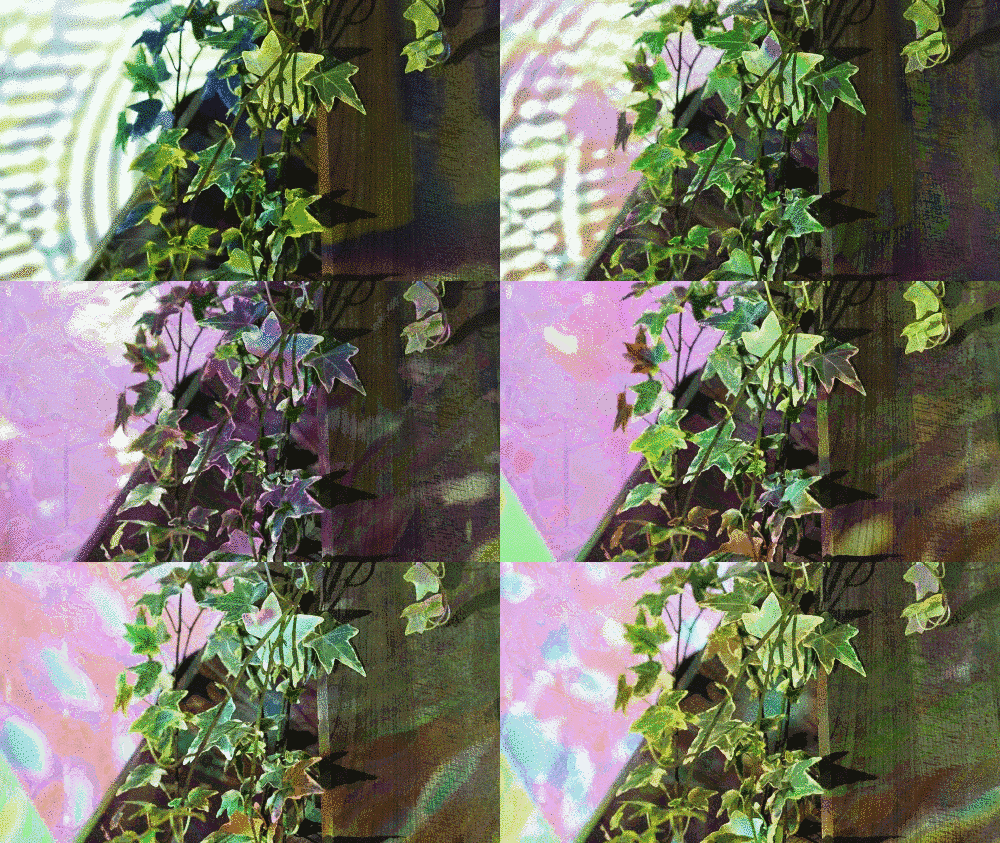
I had thought about making animations to project onto various objects, but I didn’t want to turn this into an animation project. I’ve long used my Glass video when experimenting with projections and I liked how to made any surface it landed on just way more interesting. To replicate this saturation of glitchy colour and movement I installed a copy of waaave_pool onto a Raspberry Pi, connected a webcam to it and pointed the webcam at random surfaces in the room.
Video waves itself is a bit like a video synthesiser, working primarily with webcam video input. With that installed I made some things like this:
I liked these projection experiments most when they were really subtle. I didn’t want the projection to overpower the surface and render it invisible or irrelevant. For example, in one experiment I projected onto cushions, which looked really great but the cushions got lost behind the projections.
I also played with a strip of LED lights I had from a previous project. They can be programmed to to flash quickly but they seemed to work best when they were pulsating slowly, which very much matched the pace of the shots I had filmed so far.
In the next blog post I’ll be detailing how I made sounds for the film and sharing the finished film.